
An honest discount can sit on your website for a week without reaching the people who would actually benefit from it.
You may have checked the coupon, explained the renewal price, and designed a lovely sale page. Then you share one link on social media, get a few likes from other marketers, and watch the visitor count go quiet. It is tempting to conclude that the solution is more ad spend.
Sometimes paid distribution makes sense. But WordPress businesses have another option: make the promotion useful enough for the right people to discover, discuss, and share it. A theme deal might solve an agency’s licensing problem. A booking-plugin offer may finally make sense for a salon owner planning online appointments. A discount is relevant only when it helps someone do a job they already care about.
This guide shows how to promote WordPress deals organically, without promising viral reach or asking anyone to spam a support forum. It covers search, community conversations, product education, email lists, mutually useful partnerships, short-form content, measurement, and a realistic 30-day distribution plan. The examples are illustrative, not results from campaigns run by WPTopper.
Key Takeaways (TL;DR)
- Make the deal page genuinely useful: clear terms, comparisons, answers to buying questions, and working offers.
- Use search, partner newsletters, creator collaborations, and relevant communities to reach qualified buyers organically.
- Help before promoting in WordPress communities and on Reddit; unsolicited deal-dropping can damage trust and violate rules.
- Track qualified visits, outbound clicks, and independently verified sales where available; don’t call a click a purchase.
Quick answer: what actually gets an organic deal noticed?
Start with a verified, relevant offer on a page that explains the product, license, current price, renewal terms, eligibility, and expiry. Then create several useful entry points around that offer: answer a real search query; share an informative workflow; provide a practical resource to a community that allows it; offer editorially useful information to a partner; and send a relevant note to subscribers who opted in. Measure the quality of visits and deal clicks, not only impressions.
The order matters. Distribution does not fix a confusing landing page, and the loudest post in a community will not compensate for a code that fails at checkout.
A useful way to choose distribution channels
| Channel | Best starting asset | What to measure | What to avoid |
|---|---|---|---|
| Organic search | Evergreen buyer guide plus current deal detail | Relevant search visits; clicks to verified offers | Thin pages copied from vendor descriptions |
| Existing email audience | Segmented helpful product note | Qualified clicks; unsubscribes; actual outcomes where available | Broadcasting unrelated discounts to everyone |
| WordPress communities | Standalone answer or useful tutorial | Follow-up questions; qualified referral traffic when links are allowed | Support-forum promotion and link dropping |
| Partner newsletters | Relevant, preapproved product/workflow resource | Referral visits, engaged sessions, verified clicks | Paid links disguised as editorial endorsements |
| LinkedIn and social | Small lesson, carousel, or practical clip | Saves, shares, useful replies, qualified visits | Repeating a percentage badge every day |
| Video or live demo | Real workflow and license explanation | Demonstration interest and downstream visitors | Fictional interfaces represented as real tests |
This is an editorial decision matrix, not a ranking of channel performance. What works for a small WooCommerce store may differ from what works for a theme developer with thousands of agency customers.
1. Give the offer a better home than a discount banner
Before trying to earn attention, ask a colleague to open the deal on a phone. Can they tell what the software does? Which license is discounted? Will the promotion expire at a known time? What does the subscription cost on renewal? Does the button open the developer’s real pricing page or an unrelated homepage?
For a WordPress deals directory such as WPTopper, a reader should also know who handles payment. If WPTopper refers someone to a plugin maker, the listing should say that the vendor operates checkout and owns the final payment and license terms. It should identify when the offer was last checked and avoid promising that an untested coupon is active.
A useful deal page needs three layers. The first is a decision layer: product name, concrete use case, verified price, license tier, renewal, and clear CTA. The second is an evidence layer: documented capabilities, compatibility, support policy, meaningful limitations, and the source of any ratings. The third is a maintenance layer: source URL, last-check date, expiry status, and owner of updates.
If you cannot verify the discount, publish a helpful product explanation without an “active deal” claim. That distinction can preserve reader trust and keeps a failed coupon from becoming a reputation problem.
The companion WPTopper guide, What Every WordPress Deals Page Should Show Before Someone Clicks Buy, covers the complete design and verification checklist.
2. Use search to answer a decision, not just repeat “best deal”
Search traffic is attractive because someone may already be looking for the exact thing you explain. But “WordPress discounts” is not one single search intent. A buyer searching “WordPress booking plugin price” may need a product comparison. Someone searching “coupon code not working WooCommerce” needs troubleshooting. A business owner looking for “how to create a coupon” needs a tutorial, not a gallery of discounts.
That matters for WPTopper’s editorial structure. Build connected pages with distinct jobs:
- Evergreen decision guides: How to choose a WordPress plugin, compare annual versus lifetime licensing, or judge whether a discount is real.
- Implementation tutorials: Create coupon codes, configure limits, or compare manual and automatic discounts in a checkout.
- Current offer pages: A specific vendor, product, tier, source, verified price, eligibility, and expiry.
- Seasonal campaign hubs: Timely overviews that explain which deals are available and when the information was verified.
A current deals page should not copy the same manufacturer paragraph onto fifty URLs. Google’s spam policies distinguish genuinely helpful affiliate sites from thin affiliation, where merchant descriptions are simply recycled without meaningful added value. Original analysis, tested product fit, buyer criteria, license differences, and maintained information are the value a publisher can add.
A more useful search result than “Get 50% off!”
Suppose your target is an appointment-booking plugin. Instead of a generic page called “Amazing WordPress Plugin Deal,” a product-focused page might answer: “Which appointment booking features are included in the discounted single-site plan?” It can compare staff calendars, reminders, payment options, integrations, and renewal rules, provided each claim is documented for that version.
Keep article titles accurate after the campaign ends. A page called “Active Black Friday Code” should not sit unchanged in February. Show “expired; see current vendor pricing” if that is what the evidence supports. Use evergreen guides to maintain the educational value after the promotion is gone.
Google recommends people-first content that demonstrates original experience and leaves readers with useful answers. A refreshed publication date without a substantive update is not a shortcut to better search performance.
Internal links should move people toward their next question
Link from a broad discount strategy article to the calculation article when a reader needs the math; from that article to coupon setup when they are ready to implement; from checkout advice to restrictions and testing when they are ready to launch. Likewise, a deal listing should link to the product selection checklist when the visitor may not know whether the tool suits their needs.
For WPTopper this is also a publishing requirement: the full 15-article WordFlow series needs natural, contextual links. Only point to verified live WPTopper URLs; add reciprocal links to older articles as new ones become public. Do not make every anchor read “best WordPress deals.” Write descriptive text that tells the reader what they will find.
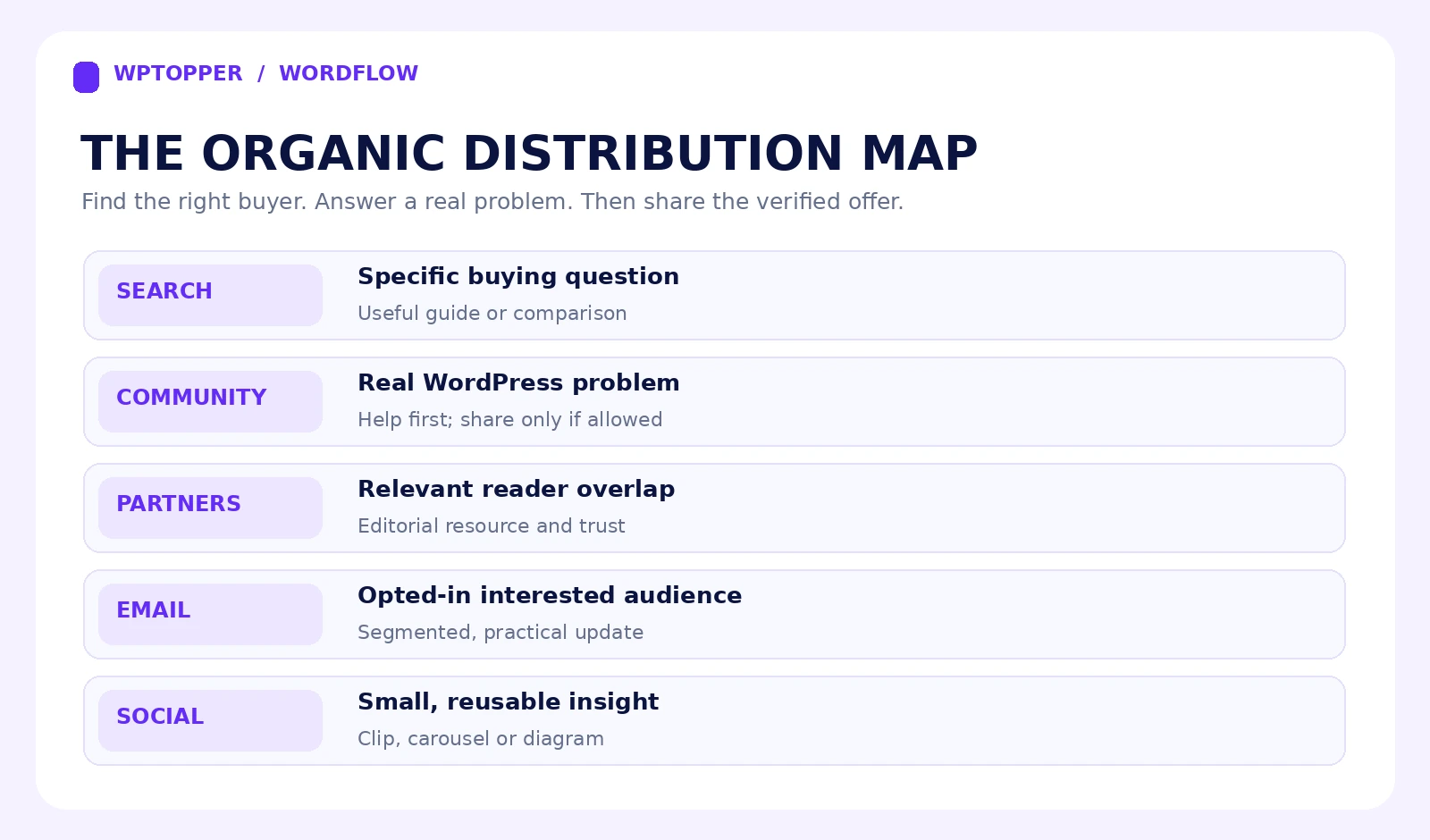
3. Share a useful answer in communities, not an unsolicited link
A good WordPress community conversation starts with somebody’s problem. Maybe a shop owner asks why a coupon is applying to agency licenses. Perhaps an agency wants to know whether annual pricing includes updates. Those are conversations you can genuinely help with, with or without a discount.
The boundary is important: WordPress.org support forums explicitly prohibit advertising plugins, themes, services, and websites. They exist for support, not as a free customer-acquisition channel. Give helpful support in that space without inserting promotional WPTopper links.
Reddit takes a context-specific approach: promotional content is not automatically spam, but its sitewide policy prohibits mass-posting, repetitive unsolicited links, and automated engagement, while each community may set stricter self-promotion rules. The often-repeated “10% rule” is not a universal permission slip. Read the rules of the specific community and ask moderators when uncertain.
A community answer that earns attention without taking over
Someone asks: “Should I buy a WordPress CRM because it’s 40% off?” An unhelpful answer is “Here’s our deals page.” A more useful answer is: “Before choosing, check whether your forms, payment tool, and email sender integrate with it; whether contact records stay portable; which automation features are included; and the renewal amount. A cheaper CRM that can’t support your workflow may be an expensive migration later.”
If the community permits relevant resources and the discussion genuinely benefits from a detailed checklist, you can share a link with your relationship disclosed. Otherwise, provide the complete answer without expecting a visit. You have still contributed something useful.
This approach rarely produces a neat number of leads per comment. That is fine. Communities are not a channel you can safely model like search ads. Treat your participation as helpful professional presence, and separately track permitted referral traffic when it occurs.
4. Create content that gives people a reason to share the deal
A discount card says how much less. A useful content asset explains what becomes possible.
For a WordPress plugin, try a short workflow demonstration with actual screens and clear annotations. For a theme, compare a responsive layout and show how it behaves on a phone. For a CRM, explain the steps from a form submission to a segmented follow-up. For a coupon plugin, show how a spending threshold protects a promotion. These resources remain helpful even after the specific offer expires.
Use a simple three-part structure for each content asset:
- The customer’s problem: One sentence in the language a real user would use.
- The practical answer: A short method, diagram, screenshot, or checklist.
- The relevant next step: A verified product explainer, demo, guide, or current deal only when it truly fits.
For example, a LinkedIn carousel called “Five things to check before buying an annual plugin license” has a natural educational purpose: renewals, updates, support, license scope, and compatibility. The final slide might point to WPTopper’s license-comparison guide. It does not need a discount badge on every slide.
Repackage one useful article five different ways
Suppose WPTopper publishes a guide about honest WordPress discounts. Turn its pricing checklist into a one-page visual, its renewal section into a short video, its coupon error examples into a developer-facing post, its audit questions into a newsletter tip, and its comparison table into a social carousel. Each version should stand on its own. Do not paste the entire article into different formats just to satisfy a posting calendar.
One detailed guide can also support a webinar, a podcast discussion, or a short tutorial video, but only if someone can contribute genuine product experience. Do not present simulated screenshots as proof of a product test.
5. Work with other publishers because the resource fits their readers
Partnership outreach works better when you understand what the other publication needs. A hosting newsletter might welcome a concise guide to evaluating renewal prices. An agency newsletter might prefer a multi-site license comparison. A plugin developer’s community might benefit from an installation tutorial or an FAQ about an integration.
Do not begin with “Please share our coupon.” Begin with a reader problem and show the specific resource you can contribute. If you have a commercial arrangement, be transparent about it. The FTC says affiliate relationships need clear, conspicuous disclosure close to the relevant endorsement; an HTML sponsored attribute alone does not inform readers.
A simple outreach note could read:
I read your guide on choosing plugins for client websites. We have a short, independently edited checklist explaining how to compare first-year discounts with renewal costs and license limits. It may be useful alongside your agency purchasing advice. Happy to send the relevant section or a graphic if it fits your editorial plans; no problem if it doesn’t.
That pitch does not promise editorial coverage, a dofollow backlink, or a positive review. Provide accurate source references and let the publisher make its own judgment. Google’s spam policies specifically warn against buying links for rankings and excessive link exchanges. If a collaboration involves payment, a free product in exchange for coverage, or compensation tied to a link, use appropriate disclosures and link qualifications.
WordCamp is a community event, not an ad inventory shortcut
WordCamp sponsorship has its own rules. The WordPress Community handbook permits factual product and savings information in approved sponsor material and certain approved coupons, but restricts unprovable superlatives and makes clear that sponsorship does not purchase a speaker slot. Event organizers also do not share attendee email lists with sponsors.
You can contribute real knowledge at an event, participate respectfully, or sponsor according to its published terms. You cannot treat the attendee list as a free newsletter database. A relevant conference connection might become a future editorial partnership, but that happens through consent and genuine mutual interest.
6. Your own email audience can be your strongest early distribution test
A modest opted-in newsletter can be more helpful than broadcasting every new article to a giant untargeted list. Segment the audience by what they said they care about: site-building, eCommerce, marketing automation, security, agencies, or another meaningful WordPress use case.
If someone subscribed for WooCommerce tutorials, a guide to evaluating holiday checkout promotions is a reasonable match. A list of theme discounts for designers may not be. The email should state one useful takeaway, explain why the linked guide is relevant, and avoid promising a live code that was not checked.
Before sending, confirm permission, unsubscribe handling, domain authentication, and that the destination matches the copy. The previous WPTopper guide, Black Friday Emails That Give People a Reason to Open, Click, and Buy, covers the detailed email sequence and sender requirements. This article treats email as one distribution channel, not another full email tutorial.
A good newsletter excerpt might read: “A 30% plugin discount may apply only to the first year. This week’s guide shows how to compare renewal costs, license limits, and the actual value of the included features before you buy.” One helpful point and one clear next step. No artificial urgency required.
7. Make the offer easy for others to reference and verify
People hesitate to share a claim they cannot check. Give partners and readers a small fact sheet for each deal. This is especially useful for a directory whose information changes regularly.
| Field | Example of what to record |
|---|---|
| Product and vendor | Verified official name and selling company |
| Eligible plan | Single-site annual license (if actually eligible) |
| Current offer | Confirmed price, currency, and source |
| Comparison price | Genuine price history or correctly labeled basis |
| Renewal | Published amount, interval, and conditions |
| Redemption | Direct sale price, code, or eligible link |
| Conditions | Exclusions, stacking, account eligibility, refunds |
| Offer dates | Start/end plus timezone when applicable |
| Verification | Source URL, date/time checked, method, owner |
| Relationship | Affiliate/sponsored status and disclosure requirement |
This is a template, not a claim that WPTopper has independently checked any particular vendor. Do not fill unknown cells with guesses. If the vendor changes its price, update the listing and advise anyone who distributed the old figure.
For an editorial affiliate site, also distinguish the seller’s actual checkout from your deal directory. Do not mark WPTopper as the seller in structured data when it only redirects buyers to a third party; Google’s merchant-listing guidance distinguishes purchasing pages from review and aggregator pages.
8. Give organic distribution a system, not endless posting
The goal isn’t to appear everywhere. It is to repeat a few relevant activities well enough to learn from them.
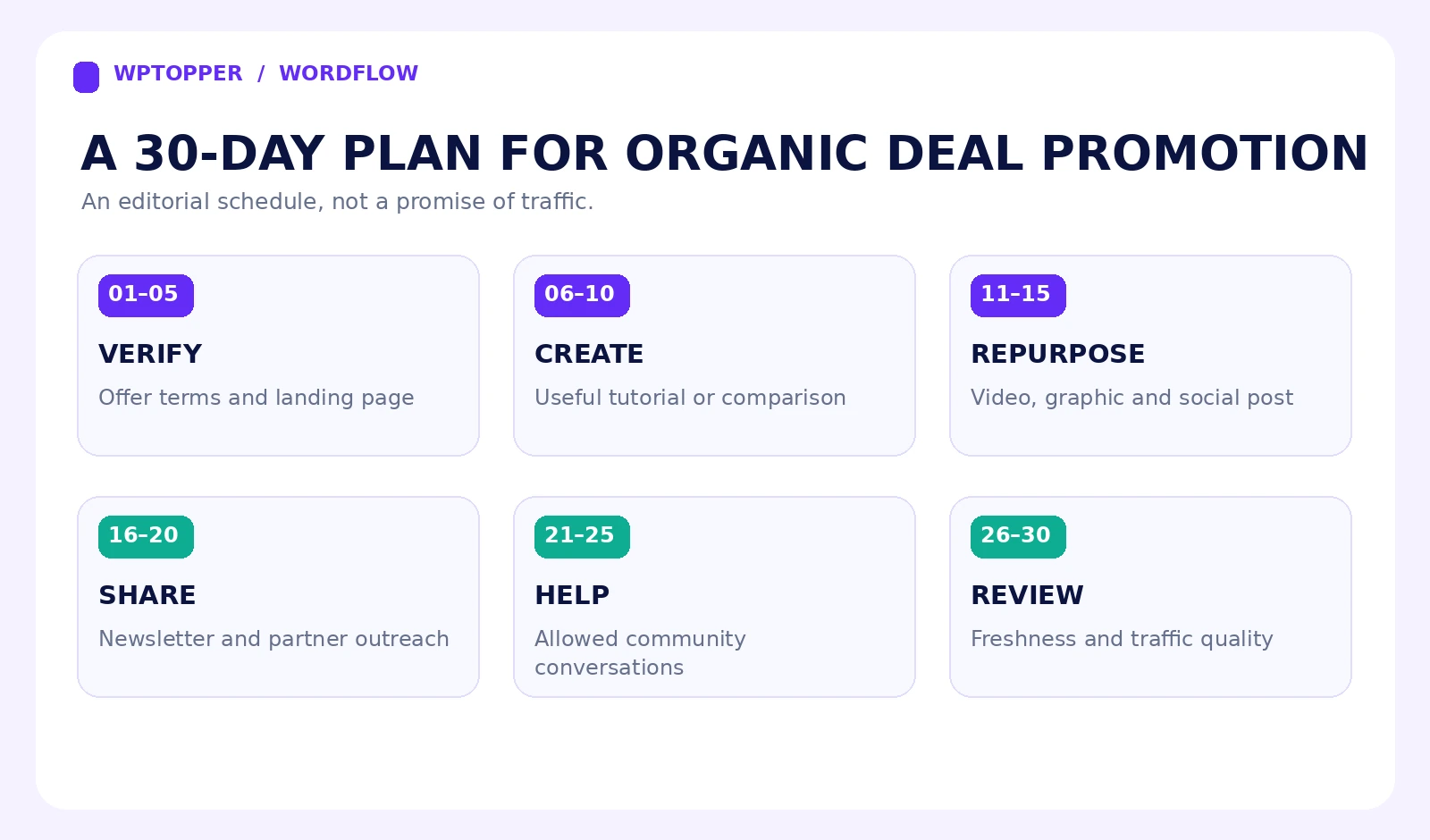
Use a weekly rhythm. On Monday, check which offers are still valid and what questions readers are asking. On Tuesday, publish a genuinely useful guide or improve an existing one. On Wednesday, create one visual or video based on that guide. On Thursday, contact a small number of carefully chosen partners or contribute meaningfully to communities that permit it. On Friday, send one relevant subscriber note where appropriate and review the evidence.
This does not mean all five activities must run every week. A small team might prioritize one excellent guide and one partner relationship over twenty scheduled posts. The system should be sustainable even when a promotion ends.
A 30-day organic plan for a WordPress deal
| Window | The work | Evidence to capture |
|---|---|---|
| Days 1–5 | Verify offer, improve deal page, decide audience and search intent | Source record, mobile check, product fit, baseline |
| Days 6–10 | Publish a tutorial or comparison that solves a related question | Completed editorial guide and internal links |
| Days 11–15 | Create a visual, short video, and one useful social explanation | Links, creative variants, relevant discussion |
| Days 16–20 | Share to opted-in audience; approach compatible editorial partners | Permission status, responses, useful referrals |
| Days 21–25 | Answer real community questions where permitted; update FAQs | New objections, corrected content, qualified visits |
| Days 26–30 | Audit links and deal freshness; analyze outcomes; plan next cycle | Traffic quality, actual clicks, corrections and lessons |
If the deal expires before day 30, stop promoting the expired price and pivot to evergreen product education. Never keep an old code visible merely because the URL still ranks.
9. Measure qualified attention, not just the reach graph
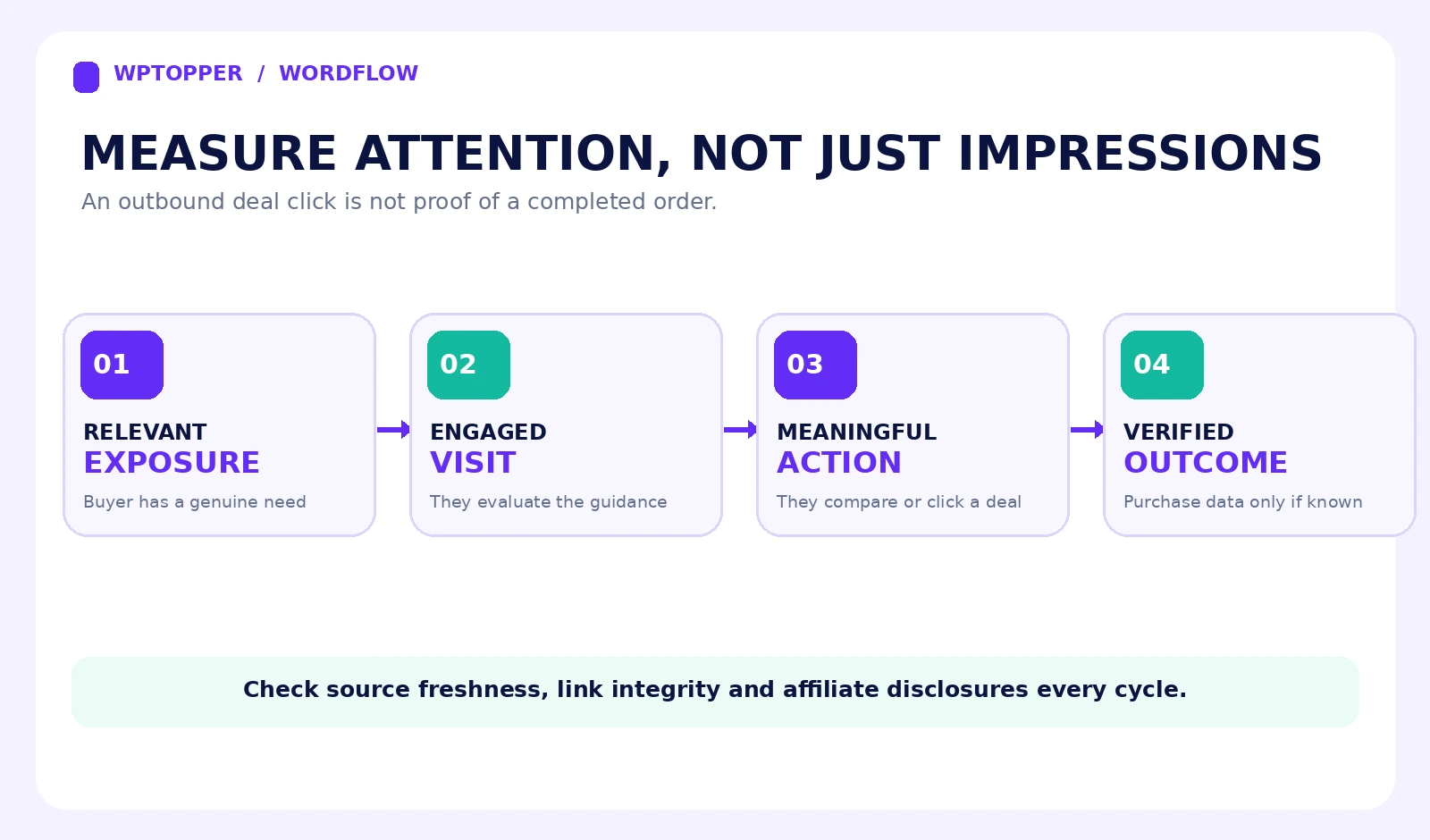
A post can reach 20,000 people who have no use for the product and produce less value than a useful guide visited by 200 serious buyers. Both numbers can be real. They answer different questions.
Track a simple chain: relevant exposure → engaged visit → meaningful action → verified outcome. On WPTopper, an outbound click is a meaningful action, but it is not proof of a purchase at the vendor’s checkout. If an affiliate partner shares valid attributed conversion records, those can add context. Otherwise, report clicks honestly as clicks.
Useful measures include organic-search landing-page visits, queries where measurable, newsletter clicks, relevant referral visits, engaged sessions, product-comparison engagement, outbound offer clicks, broken-deal reports, unsubscribe/complaint trends, and actual attributable paid outcomes if the data are available. Also measure editorial costs in working hours. “Free traffic” still requires research, writing, partnerships, maintenance, and support.
Give every campaign link a clear label
Google Analytics documents campaign parameters such as utm_source, utm_medium, utm_campaign, and utm_content. An external newsletter could use an illustrative link like:
https://wptopper.com/?utm_source=partner_newsletter&utm_medium=email&utm_campaign=wordpress_deals_2026&utm_content=guide_link
Use the real approved landing URL instead of the site root once it is known. Standardize capitalization, and test the actual destination. Do not add campaign parameters to internal navigation merely to track clicks; that can disrupt attribution of how the visitor originally arrived. For internal links, use normal analytics events or link-click measurement instead.
A simple weekly review should answer: Which audience did we reach? What useful resource brought them in? Did they read, compare, or click a verified offer? Did anything fail? What will we do differently next week? If you cannot answer, another social post probably isn’t the highest-priority action.
10. What not to do, even when the traffic graph is disappointing
Don’t promote in WordPress.org support forums. Its published guidelines prohibit advertising. Help people solve support problems, and keep promotions to appropriate places.
Don’t turn Reddit answers into repeat link drops. Community rules vary and repeated unsolicited promotion can be removed as spam. A helpful answer without a link is still a good answer.
Don’t exchange irrelevant links for rankings. Reciprocal recommendations should exist because a reader benefits, not because two sites want to manufacture authority.
Don’t turn every review into an affiliate brochure. Explain limitations, correct prices, and say what was and was not tested. Original editorial value is what separates a useful publisher from a thin affiliate page.
Don’t use old countdowns or expired codes. When an offer changes, the page, CTA, newsletter copy, and shared asset should change too.
Don’t label an outbound click as a sale. A deal publisher may not control or see the merchant checkout. Report only what the evidence supports.
An organic distribution checklist you can actually use
Before sharing a WordPress deal, check the following:
- The product and offer are useful to a defined audience, not merely “discounted.”
- The current price, comparison, eligibility, renewal, and expiry are verified or clearly marked unverified.
- The destination leads to the intended product and plan, including on mobile.
- A useful guide, demonstration, or buyer checklist gives the promotion context.
- The channel welcomes the format and the audience reasonably expects it.
- A partner or creator has editorial freedom; any compensation is disclosed.
- The email list is permission-based and subject to suppression and unsubscribe rules.
- The tracked URLs are correct, with consistent campaign parameters on external promotions.
- WPTopper pages link to related, live internal guides with natural anchor text.
- Someone owns the task of rechecking the deal and retiring outdated claims.
The hardest part of organic promotion is resisting the urge to make every interaction about a discount. The most effective editorial habit is to answer the buyer’s question first. Sometimes that earns a visit; sometimes it earns nothing measurable today. Either way, you have not spent your community’s trust on a code that might disappear tomorrow.
The WordPress deal worth sharing is the one you can explain
You don’t need to chase every social platform or paste a coupon into every community thread. Choose the reader, verify the offer, explain the purchase decision, and distribute genuinely helpful material through channels that welcome it. Then review the results without confusing attention with sales.
If you’re choosing a plugin, theme, or another WordPress tool, use WPTopper’s buyer guides to compare compatibility, license rights, renewal pricing, and current offers before committing. Product listings should link to verified WPTopper destinations, and compensated links should be clearly disclosed. A deal that holds up to questions is easier to recommend than a big number on a banner.
Frequently asked questions
How can I promote WordPress deals for free?
Build a useful deal page with accurate terms; write problem-solving search content; share relevant, nonpromotional answers where communities allow them; send useful updates to an opted-in audience; and collaborate with publishers whose readers benefit. Organic distribution has labor and production costs even without an ad budget.
Can I post my WordPress deal in the WordPress.org support forum?
No. WordPress.org’s official forum guidelines prohibit advertising plugins, themes, sites, and services. Use the forum for support and choose appropriate promotional channels elsewhere.
Is Reddit a good place to share WordPress coupon codes?
Only when the specific community allows such content and it genuinely serves the discussion. Reddit prohibits spammy repetition and mass unsolicited promotion. Being helpful without a link is often a better starting point.
What kind of blog content helps organic WordPress deal discovery?
Comparison guides, tested tutorials, honest license explanations, renewal-price guides, troubleshooting articles, and properly maintained deal pages answer distinct search intents. Avoid copying merchant descriptions without meaningful analysis.
Should I ask partners for backlinks?
Ask whether a resource will help their readers, not whether they’ll give you a ranking link. Paid or compensated coverage requires suitable disclosure and link treatment. Avoid buying ranking links or excessive reciprocal exchanges.
How do I measure a deal directory’s organic campaign success?
Track qualified visits, useful engagement, verified outbound deal clicks, reported coupon problems, and actual sales only when reliable vendor or affiliate data exist. Distinguish the effort spent from the revenue directly attributable to the campaign.
Sources and further reading
- Google Search Central, Creating Helpful, Reliable, People-First Content — https://developers.google.com/search/docs/fundamentals/creating-helpful-content
- Google Search Central, Spam Policies (thin affiliation and link spam) — https://developers.google.com/search/docs/essentials/spam-policies
- WordPress.org, Support Forum Guidelines — https://wordpress.org/support/guidelines/
- Reddit Help, Spam — https://support.reddithelp.com/hc/en-us/articles/360043504051-Spam
- Reddit Help, How Do I Keep Spam Out of My Community? — https://support.reddithelp.com/hc/en-us/articles/28012014962580-How-do-I-keep-spam-out-of-my-community
- WordPress Community, WordCamp Sponsorship — https://make.wordpress.org/community/handbook/wordcamp-organizer/planning-details/fundraising/local-wordcamp-sponsorship/
- FTC, Endorsement Guides FAQ — https://www.ftc.gov/business-guidance/resources/ftcs-endorsement-guides-what-people-are-asking
- Google Search Central, SEO Starter Guide — https://developers.google.com/search/docs/fundamentals/seo-starter-guide
- Google Analytics, URL Builders and Campaign Data — https://support.google.com/analytics/answer/10917952?hl=en
- Google Search Central, Merchant Listing Data — https://developers.google.com/search/docs/appearance/structured-data/merchant-listing
- WPTopper, How to Choose a WordPress Plugin — https://wptopper.com/how-to-choose-a-wordpress-plugin/
Research note: This guide is a researched editorial workflow, not a report of tested WPTopper campaign results. Fictional examples, outreach scripts, and tracking URLs are illustrative. Confirm the relevant details before launching your own campaign.
For the offer behind this workflow, review choosing a sustainable discount.
Leave a Reply