
A customer asks whether you have a Black Friday offer. Your competitor is advertising 40% off. Someone suggests matching it. Someone else says 50% will look better on the banner.
But if you sell a $120 WordPress plugin for $60, what actually happens? You collect less money today. The harder questions arrive later: Will more people buy? How much support will those people need? Will they renew? And how many would have paid $120 anyway?
Discount percentages aren’t magic numbers. They’re business decisions with a price tag. This guide shows you how to choose a range you can defend instead of copying what competitors announce. Every financial example below is illustrative, not a report of real WPTopper sales or an industry average.
Key Takeaways (TL;DR)
- There is no universal ideal discount for WordPress plugins or themes. Start with margins, campaign goals, and buyer behavior.
- Model several discount levels and the extra orders needed to maintain contribution before copying a competitor’s offer.
- A one-time introductory discount, recurring renewal discount, and lifetime-license deal create very different future obligations.
- Scope the offer by customer or license tier, and show the real first-payment and renewal prices before checkout.
Start with the job, not the percentage
A discount intended to attract first-time buyers is different from one meant to move a loyal customer from a single-site license to an agency plan. Both might be advertised as a holiday sale, but they require different success measures.
Before touching the coupon settings, pick one main outcome:
- Acquire new customers: Help qualified buyers get past the uncertainty of trying a new tool.
- Encourage upgrades: Give existing customers a reason to move to a higher-tier license.
- Recover genuinely at-risk accounts: Retain people with a real reason to leave, rather than discounting every upcoming renewal.
- Sell a complementary product: Increase the usefulness of a bundle, not just the size of an order.
- Reward your community: Offer something valuable without conditioning customers to wait for the next sale.
Here’s a question worth asking in a planning meeting: If we could get the same result without lowering the price, would we? When people are nervous about installation, compatibility, or migration, better documentation or a working demo may help more than a steep coupon.
Calculate your discount floor before choosing a percentage
You can’t pick a sensible discount until you know how much money an incremental sale contributes to your business. The relevant measure is contribution per order: money collected, less costs that change with that order. Stripe’s break-even explainer uses this basic relationship.
Contribution per order = selling price after discount − variable costs.
For a WordPress plugin or theme, variable costs can include payment-gateway charges, checkout or licensing platform fees, affiliate commissions, incremental support, onboarding work, and an allowance for refunds or chargebacks. Calculate these using your records, not a random benchmark.
Some costs are mostly fixed in the short run: product-development salaries already committed, hosting you were already paying for, or an annual tooling subscription. They still matter to the business, but treating all of them as if another sale creates the same extra expense can mislead a campaign decision.
Also, don’t assume payment fees are just a neat percentage. Freemius announced an updated pricing model in October 2026 that includes a percentage, a fixed per-transaction charge, and gateway fees. Your own contract, fee tier, and sales channels may differ.
A worked example: a $120 annual plugin
Imagine an annual WordPress plugin priced at $120. The team estimates:
- $18 in variable onboarding and support cost per new sale;
- a hypothetical combined selling and payment fee of 5% of the charged price plus $0.50 per order.
That fee is made up for the example; it is not a quote for Freemius, Stripe, WooPayments, or another provider.
At full price, contribution is:
$120 − $18 − $6 − $0.50 = $95.50 per order.
Now run the same calculation for four discounts.
|
Discount |
Customer pays |
Contribution per order |
Orders required to match 100 regular-price sales |
|
No discount |
$120.00 |
$95.50 |
100 |
|
10% off |
$108.00 |
$84.10 |
114 |
|
20% off |
$96.00 |
$72.70 |
132 |
|
30% off |
$84.00 |
$61.30 |
156 |
|
40% off |
$72.00 |
$49.90 |
192 |
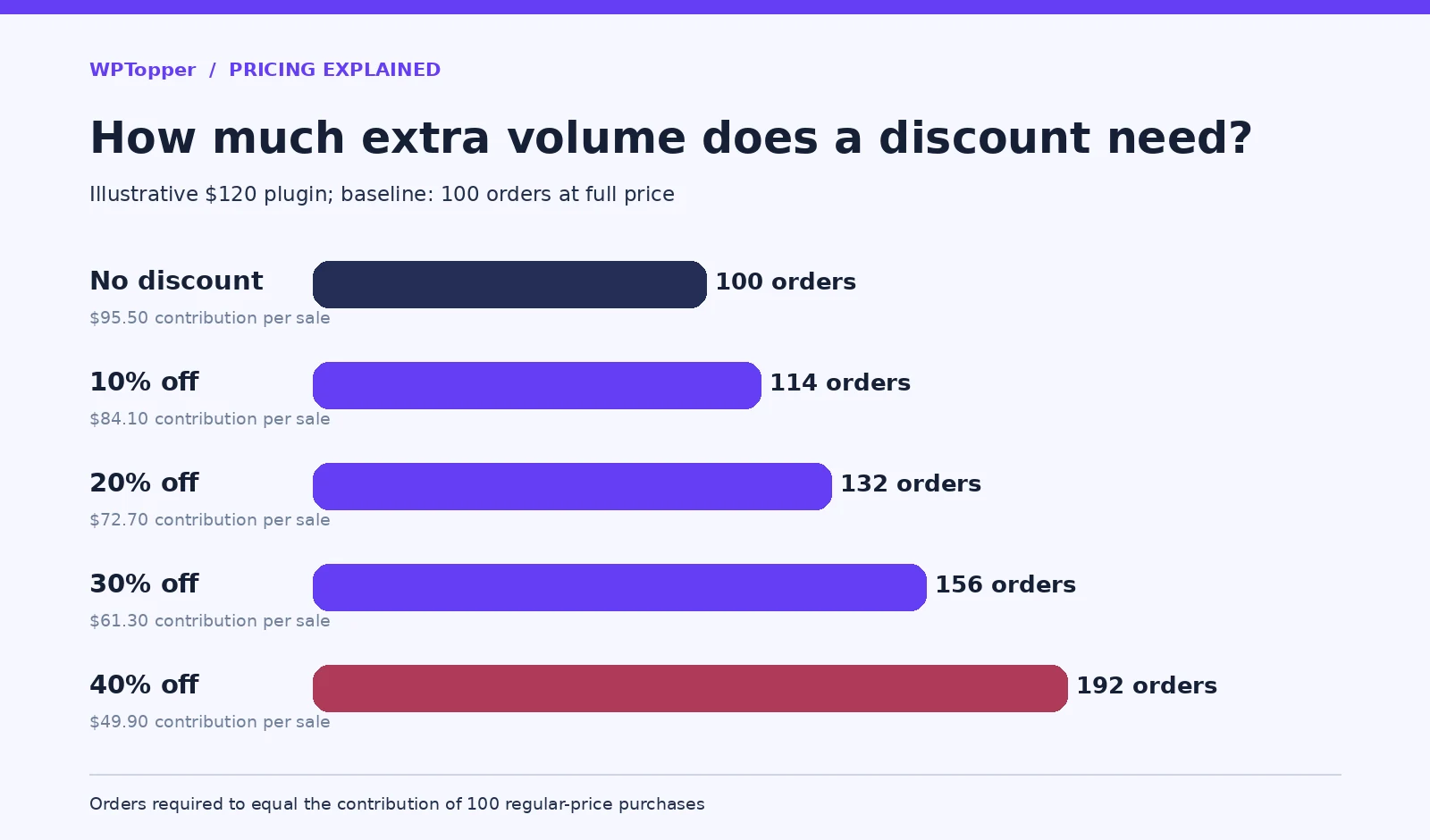
A hundred full-price sales produce $9,550 in contribution under these assumptions. At 40% off, you’d need 192 orders to reach at least that contribution. Not 140. Almost twice the volume.
This doesn’t mean 40% is always wrong. It means a deeper discount needs to produce a much bigger change in customer behavior to pay for itself. If a promotion generates 125 orders instead of 100, the growth headline sounds nice, but in this example a 30% offer would still lower total contribution.
Use this formula:
Break-even discounted orders = normal orders × (normal contribution per order ÷ discounted contribution per order)
Round up to a whole order. If discounted contribution is zero or negative, increasing sales cannot repair the economics of that order. And if you spend more on advertising or temporary support during the sale, include those extra expenses in the campaign-level target.
A price cut can be bigger than it looks
Sometimes marketing teams compare discounts as a share of revenue, when they should compare them as a share of contribution. Going from $120 to $96 removes $24 in price, but in our example contribution drops from $95.50 to $72.70. That is about 24% less contribution per order. Going to $72 cuts the price by 40%, yet contribution falls by nearly 48%.
The gap comes from the costs that don’t disappear when you lower the price. This is why the phrase “a 20% discount is only 20%” can be expensive advice.
Who receives the discount matters as much as its size
Take two customers. One has spent a week comparing your plugin with three competitors. The other is already on the checkout page with a credit card in hand. Give both the same 30% coupon and you may change one person’s mind while simply collecting less from the other.
That doesn’t make broad offers bad. Public Black Friday campaigns can generate awareness and are easy to explain. It does mean a broad offer deserves a stronger business case than a narrowly targeted one.
For first-time buyers, you could test a modest introductory discount for a particular product. For existing customers, an upgrade credit or extra site activation may be more appropriate. For agencies, a thoughtfully priced bundle can address the cost of managing multiple client sites. For a partner promotion, a dedicated offer makes the source of new buyers easier to evaluate.
Don’t overlook fairness. A campaign that gives new buyers the best terms while treating existing subscribers as an afterthought can create resentment. Loyal customers might appreciate early access, a training session, or a meaningful upgrade benefit more than another generic coupon.
Put boundaries around the offer
An offer can have a product scope, a customer scope, an order minimum, a redemption limit, or a maximum discount amount. A single headline might hide very different economics across one-site licenses and agency plans.
WooCommerce’s core coupon documentation describes percentage, fixed-cart, and fixed-product coupons with usage and product restrictions. Those settings can enforce your decision. They can’t decide whether the discount itself is wise.
For the technical steps and restrictions, this WPTopper series will cover creating WordPress coupon codes and setting coupon rules that prevent misuse. Those articles will be linked once their public pages are live.
Annual subscriptions: first-year and renewal discounts are different products
A software subscription isn’t a one-off shopping cart. Your customer may need updates, security fixes, compatibility work, and support long after purchase. The price you advertise today can affect several years of revenue.
Compare first-payment and recurring discounts
Return to the $120 plugin and its $95.50 normal contribution. A 20% first-year discount gives you $72.70 on the first payment.
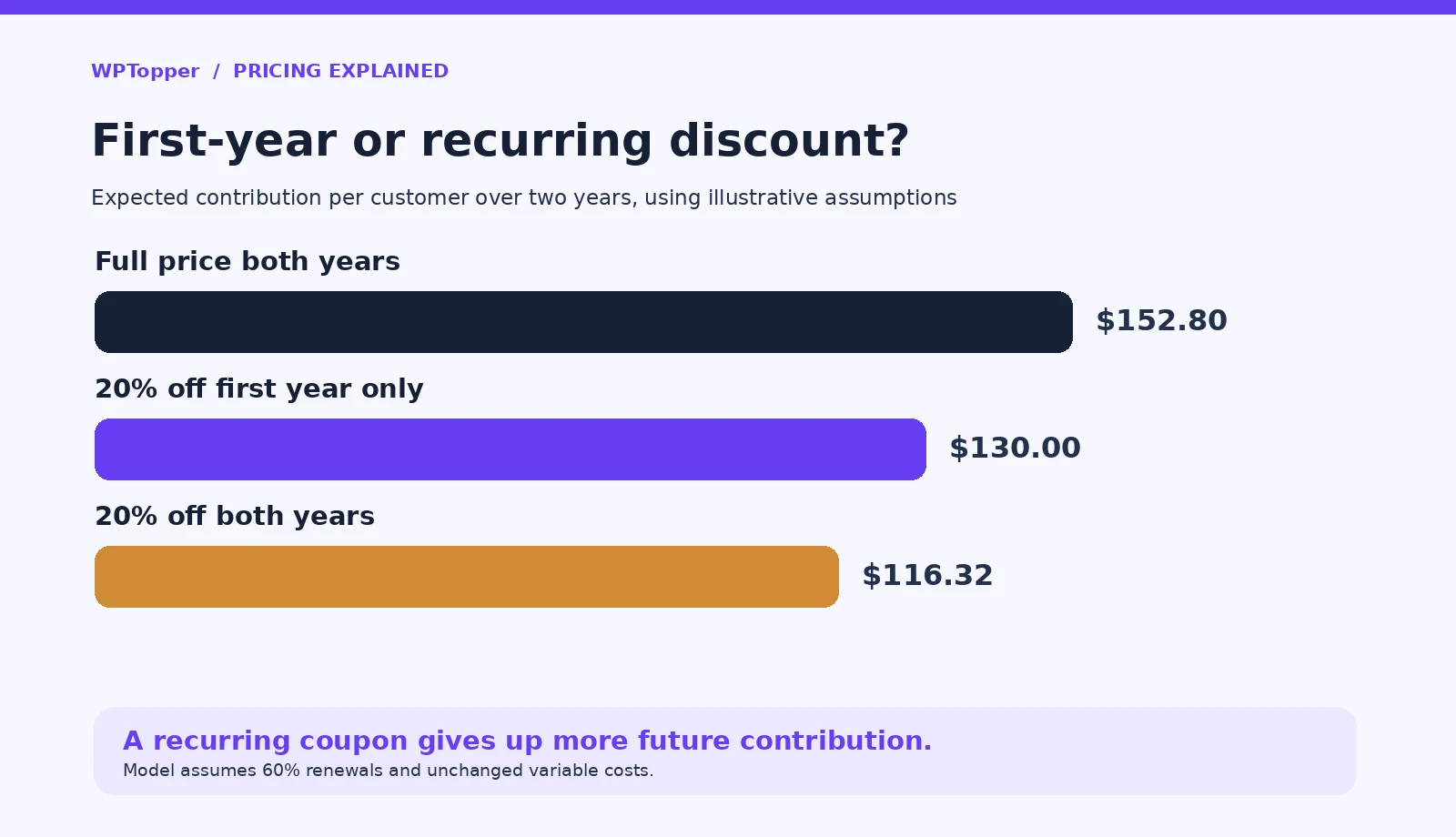
Assume, purely for illustration, that 60% of new customers renew for a second year, and that support and fee costs remain the same. Here’s what the expected contribution from the first two payments looks like:
|
Pricing model |
Year-one contribution |
Expected year-two contribution |
Expected two-year total |
|
Both years at full price |
$95.50 |
$57.30 |
$152.80 |
|
20% off first year only |
$72.70 |
$57.30 |
$130.00 |
|
20% off first and second years |
$72.70 |
$43.62 |
$116.32 |
The recurring discount gives up $22.80. That’s a different acquisition hurdle, even though both banners could say “20% off.”
This simplified comparison assumes the same renewal probability across all groups. In reality, discounting might change who buys, how they use the product, and whether they stay. Measure those differences. Don’t assume future customer value magically fills the gap.
A small billing detail can change the whole offer
WooCommerce Subscriptions explains that ordinary cart and product coupons generally apply only to the initial subscription payment, while dedicated recurring-product coupons can affect renewals. Its limited-payment coupon feature can also restrict a recurring discount to a certain number of payments. These subscription-specific functions are not the same as basic WooCommerce coupon types.
Whatever checkout you use, verify the configured behavior. Show the customer the price today, the renewal amount, and the renewal frequency. A first-year promotion is legitimate; making people search for the year-two price is not a good buying experience.
Lifetime licenses: don’t discount a promise you haven’t costed
Lifetime licenses are especially popular in the WordPress ecosystem because the customer pays once. For the seller, the hard part is figuring out what “lifetime” will cost to honor.
Let’s imagine a lifetime plan normally priced at $299, with a 20% promotion to $239.20. Suppose the transaction takes 6% in variable fees and you expect $14 in support and service costs per year over a five-year modeling period.
At the promotional price, the illustrative contribution is about $154.85: $239.20 collected, less about $14.35 in fees and $70 in five-year support costs. At the regular $299 price, illustrative contribution is $211.06 under the same assumptions.
Neither figure is a complete valuation. The cost estimate could be wrong; support demand might surge; your commitment may last well beyond five years; and a serious compatibility or security update may be more expensive than expected. We haven’t discounted future cash flows either. The point of the exercise is to make future obligations visible before taking money off a one-time payment.
Agency plans amplify the risk
An unlimited-site lifetime license may put you in touch with dozens or hundreds of installations through one paying customer. That can be great for adoption and feedback. It can also create a gap between cash collected and the support footprint that grows over time.
Model a lifetime offer with the actual site limits, support terms, expected activity, and licensing rules. Test a pessimistic case. If the business cannot comfortably support the commitment, a slightly smaller discount will not solve the underlying pricing problem.
A bundle, an annual agency tier, or an extra onboarding package may serve the same buyer without locking you into a deeply discounted lifetime obligation.
So should you offer 10%, 20%, 30%, or something else?
These are useful scenarios, not recommended industry standards. When data is limited, model a conservative offer, a middle offer, and a more aggressive one. Then compare their break-even thresholds with the extra qualified demand you can reasonably create.
A familiar, reliable plugin with steady word-of-mouth sales may need very little incentive. A less-known product entering a competitive category may benefit from a larger first-purchase offer if new customers activate the product and renew. A one-time-use utility might be better sold as a clear fixed-price purchase than as a recurring license with a dramatic first-term markdown.
Try looking at actual buyer questions before you decide. If prospects keep asking whether the tool works with a specific page builder, plugin, hosting setup, or checkout, price may not be the main obstacle. A tested integration guide or a short demo could improve conversion without lowering the price for everyone.
There’s no obligation to round 17% up to 20% just because the larger figure looks cleaner on a graphic. The most useful discount number is one grounded in your economics and your customer’s decision, not in the shape of a promotional sticker.
A 30-minute exercise for your next WordPress sale
1. Write the audience and objective in one sentence. “We want first-time buyers evaluating our single-site plan to try it during the campaign,” is more actionable than “boost revenue.”
2. Get your actual numbers. Pull recent order prices, gateway and platform fees, affiliate payouts, refunds, support effort, and the mix of new purchases versus renewals. If a cost is uncertain, write down the estimate and model an unfavorable case.
3. Calculate a full-price contribution baseline. Choose a comparable campaign period and project how many customers would likely buy without a discount. Keep seasonality and advertising changes in mind.
4. Compare three offers. For each, calculate the price paid, contribution per sale, extra orders required to keep contribution flat, and possible impact on the mix of license tiers.
5. Model the follow-on period. For annual plans, check first payment versus renewal. For lifetime plans, forecast future support. For agencies, check upgrades and multi-site usage. Avoid optimistic assumptions masquerading as known facts.
6. Write the guardrail. What would make you pause a campaign? A minimum total contribution? A maximum acquisition cost? Higher-than-expected refunds? A support backlog? Decide before the first social post goes out.
7. Check the advertised terms. The former price should be real, the duration clear, and any limitations understandable. The FTC’s former-price guidance explicitly cautions against invented or artificially inflated “before” prices. Review the applicable rules for every market where you sell.
8. Test checkout, then learn. Make test purchases using the relevant license tiers. Verify mobile checkout, coupon expiry, stacking, renewal pricing, and confirmation emails. After the campaign, review actual incremental contribution, not only gross revenue and redemption counts.
Three ways teams accidentally make a sale less profitable
They count every coupon redemption as an extra customer
A buyer who was about to pay full price can redeem a promotional code. The sale might look bigger in your coupon report while creating very little new demand. Compare with a plausible baseline, and use a holdout audience where you have enough traffic to do it responsibly.
They use one percentage for every license tier
A single-site license and a 50-site agency plan can have different buyer behavior and support costs. If you discount both identically, you might quietly weaken your upgrade path. Model each major tier before advertising a blanket percentage.
They mistake urgency for value
A larger badge doesn’t fix confusing licensing, missing features, a weak demo, or unclear renewal pricing. Some businesses build a cycle in which shoppers are reluctant to pay regular price because they expect constant promotions. A sale should solve a real reason to purchase now, not become the only reason anyone buys.
The decision I’d make with a small WordPress product team
I would start conservatively if we didn’t have reliable figures, and I would narrow the audience before deepening the discount. I’d test a clear first-year offer or an upgrade incentive, make renewal terms impossible to miss, and track whether new customers get genuine value from the product.
I’d also reserve room to say no discount. Clearer license comparisons, better setup guidance, a real demonstration, or a bundle of useful tools can be worth more than another 10% off. You can always launch a bigger discount after you learn something; you can’t retroactively charge full price to everyone who used a code.
For the broader campaign framework, see our related WPTopper guide, WordPress Discounts: How to Run a Sale Without Giving Away Your Profit. The next article in this series covers the choice between coupon codes, straight price cuts, and bundles.
If you’re on the buying side, browse WordPress products on WPTopper. Compare what a license includes, renewal terms, support, and the actual value to your project before treating the biggest percentage as the best deal.
Frequently asked questions
What discount percentage is best for a WordPress plugin?
There is no reliable universal percentage. Start with contribution per order and the audience you want to influence, then check the extra order volume needed to compensate for the lower price. Test the offer rather than assuming an arbitrary number will work.
Is 50% off too much for a WordPress theme?
It can be, especially if the theme has significant ongoing support obligations or already converts well at full price. But the percentage alone isn’t sufficient to decide. The answer depends on your costs, normal sales, customer mix, and the demand you expect the campaign to add.
Should a Black Friday discount apply to renewals?
Not by default. Customer acquisition and retention are separate decisions. An initial discount reduces one payment; a recurring discount reduces future payments too. Verify the checkout behavior and explain the renewal amount before purchase.
How do I calculate the extra sales needed to cover a discount?
Divide your normal contribution per order by discounted contribution per order and multiply by expected full-price orders during the same period. Round up to whole orders. Include any additional campaign spending in a campaign-level break-even analysis.
Are lifetime deals different from annual licenses?
Yes. Lifetime deals bring cash in once while potentially creating support and update commitments for years. You need to model that obligation, not simply apply the same discount formula used for an annual plan.
Leave a Reply