
A customer puts a $99 WordPress plugin in their cart, reaches checkout, and disappears. Two hours later, your automation sends them 15% off. They return and buy. Success, right?
Maybe. They might have come back after a simple reminder. They might have been comparing license tiers, looking for a payment method, or trying to work out whether the renewal price was different from the first payment. In those cases, the coupon didn’t solve the problem. It just made an order you might have won anyway worth less.
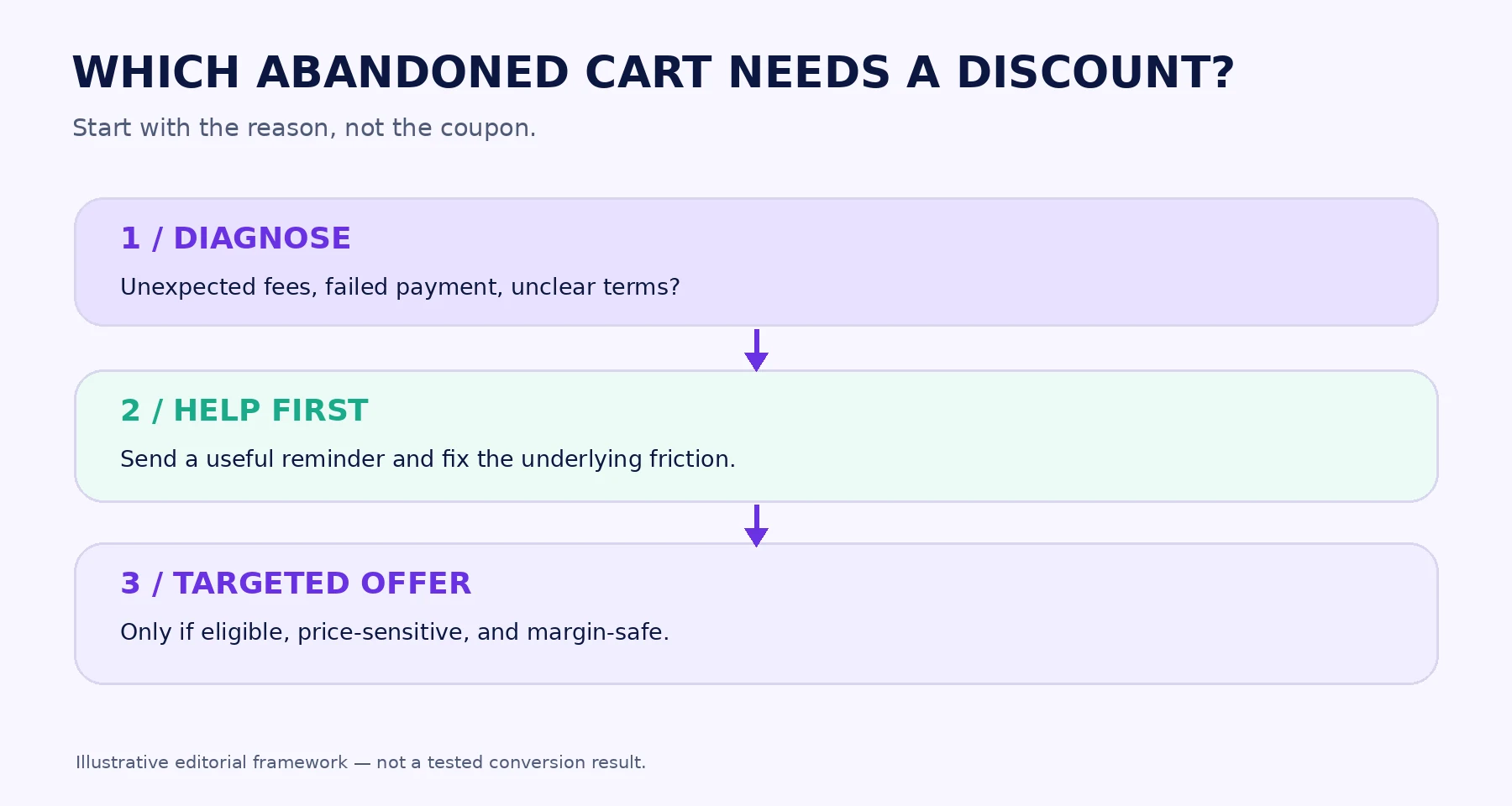
Abandoned-cart recovery should start with a question, not a coupon: Why did the shopper leave? The answer determines whether you should send a reminder, fix checkout friction, offer help, or finally consider a financial incentive.
This guide explains a more careful recovery strategy for WooCommerce, FluentCart, and WordPress businesses selling plugins, themes, memberships, or physical goods. You’ll get a decision framework, sample messages, a simple margin calculation, and an automation checklist. Examples and results are illustrative, not findings from a live WPTopper store.
Key Takeaways (TL;DR)
- An abandoned cart doesn’t necessarily signal a price objection. Check shipping, trust, compatibility, and checkout friction first.
- Start with a helpful return-to-cart reminder; reserve coupons for eligible segments when the margin supports them.
- Stop recovery messages after a purchase, refund, or opt-out and verify consent before sending promotional emails.
- Measure incremental contribution, not just attributed recovered orders; some customers would have returned without the coupon.
Quick answer: don’t discount the first recovery email by default
For most eligible shoppers, start with a short reminder that brings them back to the correct cart or payment page. If the hesitation seems connected to compatibility, shipping, support, or renewal terms, answer that question next. Reserve a limited incentive for a defined segment only if its likely incremental value can cover the cost.
That isn’t just a personal preference. Klaviyo’s abandoned-cart guidance advises against offering a coupon in the first email because shoppers can learn to abandon carts to receive one. Its recommended alternative is to wait until later in the sequence or consider an incentive for eligible first-time shoppers. (Source: Klaviyo abandoned-cart flow documentation; see references below.)
| What you know | More useful first response | When a coupon might help |
|---|---|---|
| Shopper reached checkout and left | Send a simple, accessible return-to-cart link | Later, for eligible price-sensitive first-time shoppers |
| Delivery charge surprised the shopper | Make delivery, fees, and dates clear; fix policy or presentation if needed | A narrowly scoped shipping incentive only if affordable |
| Buyer is comparing plugin licenses | Explain the right tier, site limits, and renewal terms | An approved upgrade credit, if price is genuinely the obstacle |
| Payment failed | Provide a secure retry path and support contact | Usually not until the payment issue is resolved |
| Existing customer with a repeat cart | Recognize the relationship and offer help | Only when retention evidence supports it |
| Someone already purchased elsewhere on your site | Stop recovery communication | Do not send a coupon |
This is an editorial decision guide, not proof that a particular segment converts at a specific rate. Your actual customer feedback should improve the rules over time.
Why people abandon carts in the first place
A cart is a signal of interest, not a signed purchase order. Shoppers add products while comparing alternatives, saving an item for later, estimating delivery, or checking whether the checkout accepts their payment method. Some would never have bought that day, with or without a coupon.
Baymard’s 2026 cart-abandonment research notes that 42% of surveyed US shoppers who had abandoned carts said they were just browsing or not ready to buy. Among abandonment reasons reported after excluding that browsing segment, the study lists high extra costs at 40%, slow delivery at 20%, concerns about sharing card information at 19%, forced account creation at 18%, and complex checkout at 17%. Those figures describe the research sample and reported reasons; they are not WPTopper’s checkout analytics and shouldn’t be added together as if reasons were exclusive. (Source: Baymard 2026 cart abandonment data; see references below.)
Look at those causes individually. A $10 coupon won’t make tomorrow’s delivery arrive today. It doesn’t make an untrusted payment screen trustworthy. It may soften an unexpected fee, but showing the fee early might be the real fix. And it does little for someone whose main concern is whether a plugin works with their WordPress setup.
The checkout experience can create its own coupon hunt
Baymard has separately observed shoppers leaving checkout after seeing a coupon-code field, specifically to search the web for discounts. If your promotion is already public and everyone eligible should receive it, an empty code field can turn a straightforward purchase into another decision. Consider making the public price clear and reducing unnecessary form friction. (Source: Baymard checkout form fields research; see references below.)
Ask three questions before designing an email: What did the shopper see? What information was missing? What will be different when they return? If the answer to the last question is only “the price will be lower,” you’ve probably skipped a useful diagnosis.
Fix the leaks before paying people to come back
Imagine your cart abandonment report spikes after you add a mandatory account-creation step. It’s tempting to activate a coupon sequence because the recovery dashboard can show revenue quickly. But you would be discounting around a usability problem you introduced yourself.
Start with a quick diagnostic pass through your own checkout on a phone, with a guest session and a normal customer account. Check whether the product details match the landing page; whether taxes and delivery are visible early; whether the payment gateways work; whether the discount field interrupts the process; and whether a failed payment leaves a safe path to retry without placing duplicate orders.
For WordPress software, check a different list as well: What does the plan include? Is it one site or several? Is support included? What happens after the introductory year? Can the buyer change tiers later? A short paragraph answering a real licensing question can be more valuable than another promo code.
An abandoned-cart email cannot repair a broken checkout. Fix the root cause, then use recovery messages for shoppers who still need a useful nudge.
Decide who deserves a discount before deciding how much
Don’t send every cart the same offer. A first-time shopper discovering an unfamiliar plugin may need reassurance. An existing customer renewing a product they use every day may need an invoice or a payment retry. A shopper with multiple visits to a pricing page might be weighing license options. These aren’t interchangeable situations.
A practical segmentation plan starts with data your store can lawfully and reliably use:
- New versus existing customer: Avoid making established buyers feel penalized while recognizing when an introductory benefit might actually change the decision.
- Cart value and product economics: A low-margin physical product and an annual software plan absorb discounts differently. Don’t set a universal percentage without modeling both.
- Product and license tier: A single-site annual plugin, agency license, and lifetime tier carry very different future support obligations.
- Observed checkout problem: Payment failure, repeated shipping edits, or a customer-service conversation should route to help before promotion. Only use data your tools actually capture.
- Prior offer behavior: Repeatedly discounting after every abandoned cart can condition shoppers to delay. Track patterns without accusing legitimate repeat visitors of gaming the system.
- Communication eligibility: Possessing a billing address doesn’t automatically give permission for every kind of marketing message in every jurisdiction.
Your policy should be explainable in one sentence: “We may offer a small one-time incentive to eligible first-time buyers after a helpful reminder, if the product’s contribution margin supports it.” That is a rule an editor, store operator, and support agent can all understand.
The profit calculation that should happen before the coupon
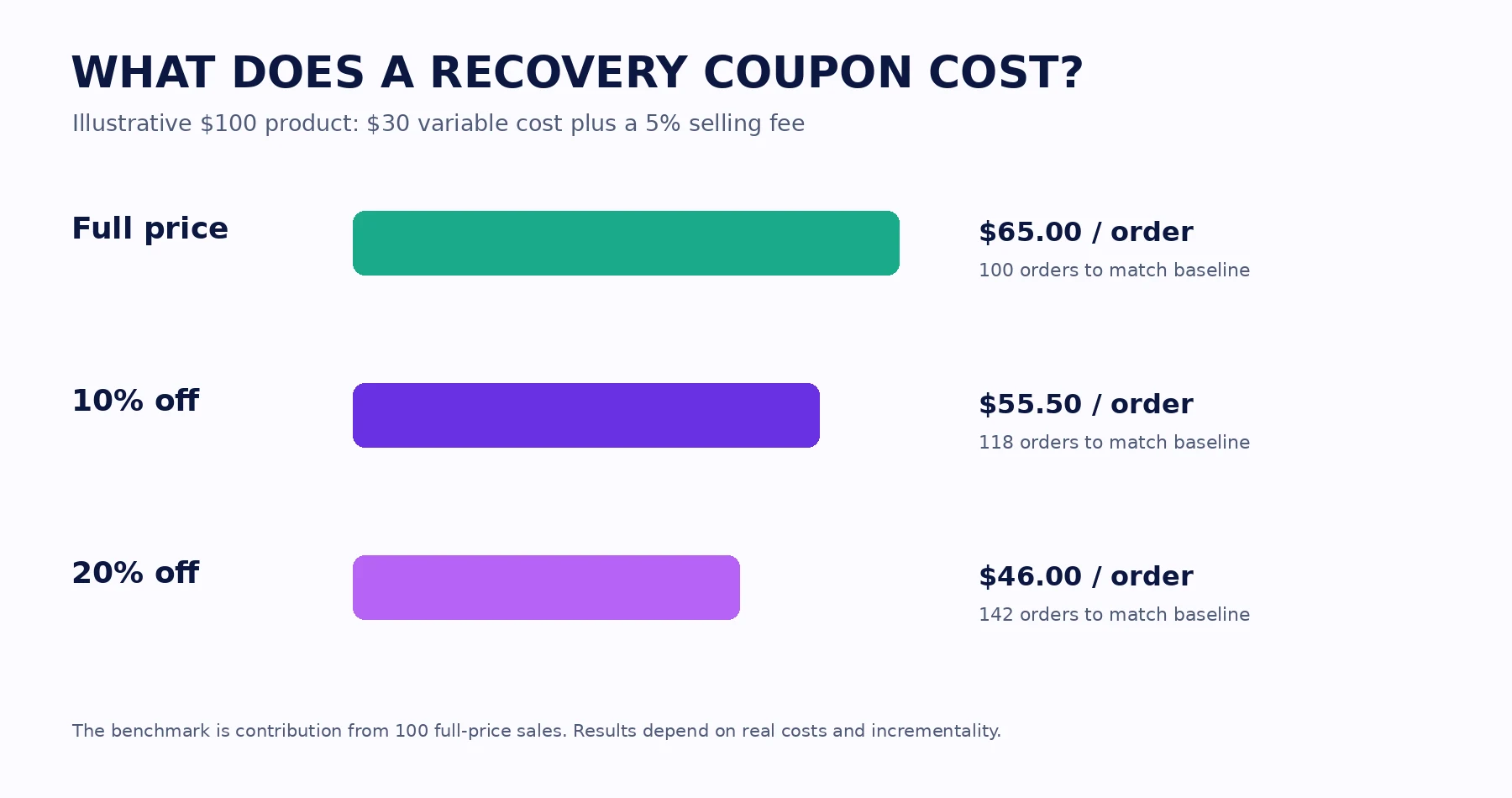
Suppose a fictional plugin sells for $100. For each order, assume $30 in variable onboarding/support or other order-linked costs, plus a hypothetical payment/platform charge equal to 5% of the actual selling price. These numbers are deliberately simplified and are not specific fees from WooCommerce, FluentCart, or any payment provider.
At full price: $100 − $30 − $5 = $65 contribution per order.
With a 10% discount, the buyer pays $90. Costs are $30 plus $4.50, leaving $55.50 contribution per order. You now need 65 ÷ 55.5 ≈ 1.17 times as many orders to earn the same contribution: roughly 118 discounted orders instead of 100 full-price orders.
With a 20% discount, the buyer pays $80. Contribution becomes $80 − $30 − $4 = $46, and the break-even multiplier rises to 65 ÷ 46 ≈ 1.41: at least 142 discounted orders instead of 100. This ignores additional campaign spend and any differences in support demand.
| Offer | Customer pays | Contribution per order | Orders to match 100 regular sales |
|---|---|---|---|
| No discount | $100 | $65.00 | 100 |
| 10% off | $90 | $55.50 | 118 |
| 20% off | $80 | $46.00 | 142 |
Important: That table does not mean every recovery campaign needs 42% more sales. It shows what would happen if all 100 expected full-price orders were also discounted. In a targeted cart-recovery flow, the harder question is how many recovered buyers would have returned without the coupon. An incremental-purchase experiment is needed to estimate that.
A recovered order isn’t necessarily an incremental order
Think of two shoppers. One gets your reminder email, sees the original price, and buys. The other would also have bought at the original price tomorrow but receives a 20% code tonight and uses it. Both are counted as “recovered” in a typical automation report, but the second recovery didn’t prove that the coupon created a sale.
Measure at least two things separately: attributed recovery, which shows that a previously abandoned cart later became an order, and incremental lift, which estimates how many additional orders the intervention created versus an appropriate no-coupon comparison. If you can’t run a large experiment, be clear about that limitation and combine small tests with qualitative support feedback.
A three-message recovery sequence that doesn’t start with a discount
A good recovery email sequence is not three versions of “Hurry.” Give each message a different job and stop the sequence as soon as the order is completed or the recipient opts out. Suggested timing below is an editorial starting point, not a universal benchmark; adapt it to your product, customer expectations, and actual checkout setup.
Email 1: The helpful reminder (after a suitable inactivity window)
Subject: Did you mean to finish your WordPress plugin order?
You were looking at the your selected product and license but didn’t complete checkout. If you were interrupted, you can return to the order using the button below.
Before you decide, you can also review the license details, compatibility information, and renewal terms. If something went wrong with payment, reply and we’ll help.
CTA: Return to your checkout
This message doesn’t need a coupon. It needs to make the next action simple and safe. Use a validated recovery URL, not a stale cart ID in a generic homepage link. Never include card details or sensitive personal data in an email.
Email 2: Answer the likely objection (approximately a day later, if still eligible)
Subject: Three things worth checking before you buy
Still comparing your plugin with other options? Here are the three questions that matter most: Does it work with your WordPress setup? Which license covers the sites you manage? What will you pay on renewal?
We’ve linked the current feature and pricing details below. If an integration or license limit is unclear, our support team can help you choose the right option.
CTA: Check license and compatibility details
The exact questions should come from genuine pre-purchase inquiries. For physical goods, replace license language with size, delivery, returns, or other real objections. Do not manufacture testimonials to make the message persuasive.
Email 3: An incentive only if the case is strong (another day later, where appropriate)
Subject: An optional offer on your eligible order
If price is the main reason you’re holding off, we have a limited offer for eligible product and license purchases. You can save the discount shown in your offer using the code or offer link included in your account before the published deadline and timezone.
The offer applies to eligible licenses and customers listed in the offer terms and first payment only; standard renewal pricing applies. Check the final amount and renewal terms before completing payment.
CTA: Review the eligible offer
Don’t send that message to everyone by default. It belongs only to a segment with an authorized, margin-tested offer. If you have no evidence that an incentive is useful, skip Email 3 or make it a final non-discount support check-in. Avoid fake “last chance” language and don’t promise a coupon your store cannot enforce.
How to build recovery in WooCommerce and FluentCRM
There’s an important current product distinction. WooCommerce documentation describes an experimental abandoned-cart recovery email in WooCommerce 11.0, disabled by default, that sends at most one eligible reminder. When enabled for automatic sending, it is scheduled for a qualifying pending order after two hours; a manual action has its own eligibility rules. This is not the same as a fully segmented three-email coupon campaign. Check your installed version and whether the experimental setting is available before promising that the feature exists in every WooCommerce store. (Source: WooCommerce abandoned cart recovery email documentation; see references below.)
For a multi-step workflow, use a compatible recovery extension or FluentCRM where the feature is available. FluentCRM’s current documentation describes abandoned-cart drivers for WooCommerce classic and block checkout and for FluentCart. It tracks once the customer reaches checkout and a billing email is available; adding a product to the cart without starting checkout doesn’t create a tracked cart in that workflow. (Sources: FluentCRM abandoned-cart settings and automation documentation; see references below.)
A careful setup path looks like this:
- Enable the recovery module in FluentCRM → Settings → Abandoned Cart Settings and the appropriate commerce driver. Define the inactivity cut-off, customer-role exclusions, and order statuses that mark carts recovered.
- Build a cart-abandoned automation with appropriate contact-status and cart conditions. Start with a reminder before adding any coupon branch.
- Set a cool-off period and rules to avoid repeatedly contacting the same buyer. Confirm unsubscribed or otherwise ineligible contacts are not sent promotional messages.
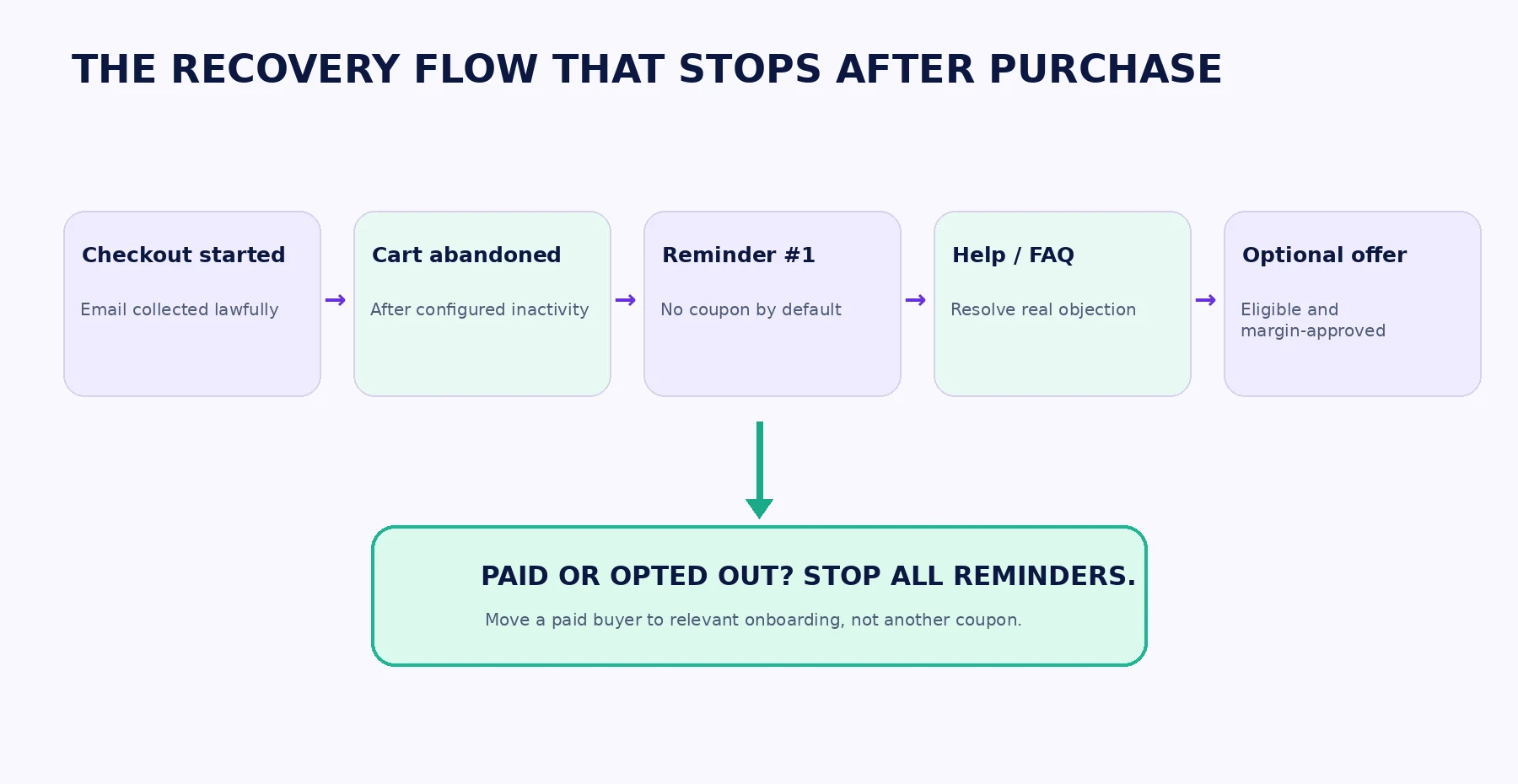
- Configure the purchase/recovered exit. If an order is paid, stop later reminders rather than delivering a coupon after the shopper already bought.
- Test with a guest email and a normal logged-in shopper, not only an administrator account. FluentCRM warns that user-role tracking exclusions and WP-Cron can prevent a test cart from entering automation.
- Check the Abandoned Carts report and distinguish recovered, processing, and lost records from incremental profit claims.
FluentCRM documentation states that its abandoned-cart background task runs on a five-minute schedule after the configured cut-off, so immediate triggering isn’t a safe test expectation. Its FluentCart driver is included in FluentCRM core; individual automation templates, Pro-dependent actions, and plugin-version capabilities still need verification for your installation. (Sources: FluentCRM driver settings, automation documentation, ecommerce triggers; see references below.)
What changes for FluentCart?
The decision logic stays the same, but the trigger and recovery statuses are FluentCart-specific. FluentCRM documents a Cart Abandoned (FluentCart) trigger, and its settings allow the store to choose which FluentCart order statuses mark a tracked cart recovered, generally successful payment/processing states depending on configuration. Don’t copy a WooCommerce pending-payment rule into FluentCart without reviewing the actual settings. (Sources: FluentCRM FluentCart integration and driver settings; see references below.)
If a discount is approved, create and test its eligibility using the relevant commerce platform’s coupon features. A coupon-bearing checkout link is not a loophole: the store still needs to validate the coupon and show honest first-payment and renewal amounts. Ensure the recovered customer is not re-entered into the flow after purchase.
Consent, frequency, and data privacy aren’t footnotes
A shopper typing an email into checkout isn’t universal permission for a promotional sequence. Legal bases, consent requirements, and treatment of cart reminders differ by location, the relationship with the buyer, and the content of the message. The presence of a built-in automation setting doesn’t settle your compliance obligations.
For US commercial emails, the FTC’s CAN-SPAM framework addresses truthful sender information, subjects, a postal address, and opt-out mechanisms. Other markets, including the EU and UK, may impose consent or other electronic-marketing requirements. Ask your legal or privacy owner to confirm a compliant use case before enabling tracking and follow-ups. Honor opt-outs across systems, including your CRM and ecommerce extension.
Keep the sequence proportionate. A person who ignores three reminders doesn’t need seven more. Suppress recent purchasers, resolve failed payments with help rather than discounts, and do not use recovered-cart data for unrelated promotions without a valid basis.
How to measure whether the incentive actually worked
Recovery reports are useful operationally. FluentCRM’s Abandoned Carts report, for example, distinguishes recovered, processing, and lost revenue. But an attributed recovery dashboard cannot on its own tell you whether a coupon caused the purchase, and revenue without discounts, refunds, and variable costs isn’t profit. (Source: FluentCRM Abandoned Cart Report; see references below.)
A practical scorecard includes eligible abandoned checkouts, reminders sent, delivered messages, return-to-cart visits, paid recovery orders, net recovered revenue, incentive cost, refunds, and estimated contribution. Segment the report by first-time versus existing customers, product/plan, and whether an incentive was offered.
For a more honest experiment, hold the amount and copy consistent, then randomly give comparable eligible abandoned shoppers a no-coupon reminder or the same reminder with a coupon in a later touch. Set rules before the test, exclude recent purchasers, and assess incremental contribution per eligible abandoned checkout rather than only total coupon redemptions. Use sufficient sample size, and disclose uncertainty if your store doesn’t have enough volume to distinguish the outcomes.
Do not compare one audience’s Monday non-discount reminder with a different audience’s Black Friday coupon and call the difference caused by the discount. The timing, traffic, offer, and buyer intent changed together.
A 12-case pre-launch checklist
Before publishing a recovery flow, a team member should run all of these scenarios in staging or a permitted test environment:
- Logged-in eligible shopper reaches checkout and leaves; the cart is recorded after the expected delay.
- Guest shopper enters a billing email, leaves, and is tracked only under the configured consent and role rules.
- Visitor adds to cart but never visits checkout; confirm whether your chosen tool tracks this at all.
- Shopper completes payment before Email 1; no recovery message is sent.
- Shopper purchases after Email 1; Emails 2 and 3 are cancelled.
- Shopper unsubscribes; no further promotional reminders are sent.
- Ineligible product, license tier, or customer; no unauthorized coupon is granted.
- Eligible first-time shopper uses the offer; exact first payment and renewal terms match the message.
- Coupon expires or reaches usage limit; the return link fails clearly and safely.
- Payment fails; retry doesn’t create duplicate charges or duplicate orders.
- Tracking and recovery URLs work on mobile, including with relevant privacy settings.
- Reporting distinguishes a paid recovered order from a mere click, and test orders are not mistaken for real revenue.
Capture the installed plugin versions, expected behavior, actual result, screenshots, and contact/checkout state for failures. Never present conceptual graphics as admin screenshots or describe testing as complete until somebody has performed it.
When a discount is the right answer
There are cases where a recovery incentive is reasonable: a first-time buyer with credible price sensitivity; a limited-margin-approved introductory offer for a specific plan; a modest shipping incentive to resolve a genuine extra-cost barrier; or a customer-service credit issued after a real inconvenience. The offer should have a business purpose, clear eligibility, and a real end point.
Even then, ask whether a better explanation would do the job. On a WordPress plugin page, a single compatibility answer may eliminate the hesitation. On a membership product, billing clarity could matter more than 10% off. On a physical-goods store, delivery terms could be decisive.
And if your checkout itself is broken, stop the recovery campaign until the underlying issue is fixed. Paying shoppers to re-enter a broken checkout is not a retention strategy.
The cart isn’t a failure; it’s unfinished information
Someone who leaves checkout isn’t automatically asking you to lower the price. They may be asking a question they haven’t found an answer to, dealing with a technical problem, or simply choosing not to buy yet. You can respect that decision and still make a useful return path available.
The sustainable order is simple: repair friction, send a relevant reminder, answer the real objection, and offer a narrowly targeted discount only when it can earn its keep. That approach leaves more room for customers to trust your next full-price offer.
For the wider picture, read WPTopper’s companion articles on WordPress discount strategy, sustainable coupon amounts, checkout experience, coupon restrictions, and Black Friday email marketing once their verified public links are available. If you’re still deciding which WordPress tool to buy, browse WPTopper’s product guidance and independently verify license terms and active deals before purchasing.
Frequently asked questions
Should I put a coupon in the first abandoned-cart email?
Usually start with a helpful reminder. Klaviyo’s current guidance discourages a first-email coupon because it can encourage strategic abandonment, and some shoppers will return without an incentive. Test your own audience before making a blanket policy.
What is a good abandoned-cart recovery discount?
There’s no universal percentage. Model contribution margin, the customer’s likely reason for leaving, renewal or lifetime support obligations, and the additional orders needed to justify the offer. A small targeted incentive may beat a larger storewide coupon.
Can WooCommerce send abandoned-cart emails without a paid plugin?
WooCommerce 11.0 documentation describes an experimental, disabled-by-default single recovery email for eligible checkout orders. Availability and behavior depend on your installed version and settings. For complex multi-step incentives or segmentation, evaluate an appropriate extension or CRM automation.
Does FluentCRM support abandoned carts for WooCommerce and FluentCart?
Its current official documentation describes both drivers, including WooCommerce classic/block checkout and FluentCart checkout. The tracking starts after checkout begins and an email is available. Review your installed version, consent configuration, scheduled tasks, and automation conditions.
Does a recovered-cart report prove the email worked?
It supports attribution to a recovery flow, but not necessarily causation. Some buyers would have returned without it. Use controlled comparisons where practical and account for incentives, refunds, variable costs, and customer quality.
Should I keep sending reminders if someone buys?
No. Verify the automation’s recovered-order exit and cancellation logic, stop promotional cart messages after payment, and move appropriate customers to helpful onboarding instead.
Sources and further reading
- Baymard Institute — 2026 Cart Abandonment Statistics: https://baymard.com/lists/cart-abandonment-rate
- Baymard Institute — Checkout Form Fields and Coupon Search Behavior: https://baymard.com/research-articles/checkout-flow-average-form-fields
- Klaviyo — How to Create an Abandoned Cart Flow: https://help.klaviyo.com/hc/en-us/articles/115002779411
- Klaviyo Academy — Anatomy of an Abandoned Cart Flow: https://academy.klaviyo.com/en-us/quick-guides/anatomy-of-a-flow-abandoned-cart
- WooCommerce — Abandoned Cart Recovery Email Documentation: https://woocommerce.com/document/managing-orders/abandoned-cart-recovery-emails/
- FluentCRM — Abandoned Cart Settings: https://docs.fluentcrm.com/abandoned-cart-settings
- FluentCRM — Abandon Cart Automation: https://docs.fluentcrm.com/abandon-cart-automation
- FluentCRM — FluentCart Integration: https://docs.fluentcrm.com/fluentcart-integration-with-fluentcrm
- FluentCRM — Abandoned Cart Reports: https://docs.fluentcrm.com/abandoned-cart-report
- US FTC — CAN-SPAM Compliance Guide: https://www.ftc.gov/business-guidance/resources/can-spam-act-compliance-guide-business
Research note: All customer examples, calculations, and email copy are illustrative. The platform setup is documented, not independently exercised on an authorized staging site. Coupon eligibility, automated sending, consent, first-payment and renewal amounts, and live deal listings need testing before publication.
For the offer behind this workflow, review choosing a sustainable discount.
Leave a Reply