
WordPress gives you a strange problem: you can build an absurd amount of a website without paying for plugins at all.
As of July 2026, the official WordPress Plugin Directory lists more than 68,000 free plugins. That means almost every job — forms, SEO, backups, security, eCommerce, analytics, caching, CRM, bookings, memberships, social proof — has at least one free option.
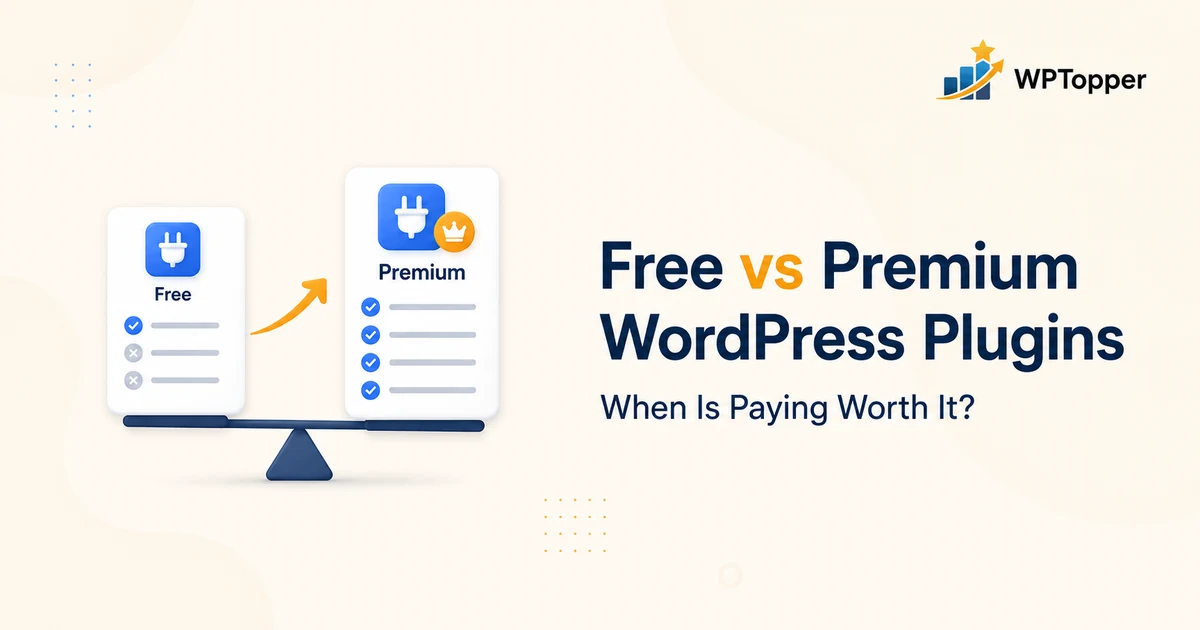
So why do people keep paying for premium plugins?
Because the real question is not “Can the free plugin do this?”
It is:
“Will the free version still be the cheaper choice once I count my time, support needs, integrations, risk, and future growth?”
That is where the decision gets interesting.
A premium plugin is not automatically better. A free plugin is not automatically limited. Some free plugins can comfortably run critical websites for years. Some premium plans are mostly convenience. Others can save enough time in one month to justify a full year of cost.
This guide gives you a practical way to decide which side you are on.
Quick Answer: When Is a Premium WordPress Plugin Worth Paying For?
Pay for a premium WordPress plugin when the paid version removes a real operational problem: recurring manual work, missing integrations, limited automation, business-critical support gaps, scaling limits, or expensive custom development.
Stay on the free version when it already solves the complete job, the workflow is low-risk, you do not need the locked integrations, and you are comfortable handling setup and troubleshooting yourself.
A good rule is simple:
If the value you gain or the cost you avoid is greater than the plugin cost, premium is probably worth it.
If the upgrade mostly gives you features you “might use someday,” keep your card in your wallet.
What “Free” and “Premium” Actually Mean in WordPress
The labels sound simple, but WordPress plugins are sold in several different ways.
1. Free-only plugins
These plugins are available without a paid edition. The developer may fund the project through donations, sponsorships, client work, a related product, or simply maintain it as an open-source project.
Free-only does not mean amateur. A focused plugin with one job can be more useful than a giant commercial plugin with 70 settings you never touch.
2. Freemium plugins
This is probably the model most WordPress users recognize.
You install a useful free plugin, often from WordPress.org. The developer also sells a Pro version, add-on, bundle, cloud service, or license that adds more capability.
The free version should still be a real product. WordPress.org’s plugin guidelines explicitly prohibit trialware in the directory. A plugin cannot simply work for 14 days and then disable its local functionality until you pay. The directory does allow paid external services and premium add-ons, provided the plugin follows the directory rules.
That distinction matters. A good freemium product gives you a usable starting point, then charges when your needs become more advanced.
3. Premium-only plugins
Some plugins are sold only through the developer or a marketplace. You buy before installing the commercial package.
This model can make sense when the product is built for a narrower professional use case, requires sustained support, or does not need a free acquisition channel.
Premium-only still does not guarantee quality. You need the same checks you would run on any other plugin: maintenance, compatibility, documentation, support, performance, developer history, and exit path.
4. Service-connected or SaaS plugins
Some WordPress plugins are really the bridge between your website and a hosted service.
Think email delivery, analytics, image optimization, security scanning, backups, AI services, payment processing, or video hosting. The plugin itself may be free, while the external service charges based on usage, storage, contacts, requests, sites, or another metric.
WordPress.org permits this “serviceware” model when the external service provides meaningful functionality and the relationship is documented clearly.
This is why “free plugin” does not always mean “free system.”
Free Does Not Mean Low Quality
There is a bad shortcut in WordPress buying advice: free for beginners, premium for serious businesses.
Reality is messier.
A free plugin can be the better choice when it is mature, actively maintained, focused, well documented, and already covers the exact job you need. You do not get bonus points for paying money to solve a problem that was already solved.
WordPress itself is open-source software. Plugins hosted in the official directory must be GPL-compatible, and the directory gives developers infrastructure for distribution, reviews, statistics, and community support forums.
That creates an ecosystem where genuinely useful software can be free without being a “demo.”
The right question is not whether the plugin costs $0.
The right question is whether you can trust it to do the job you are assigning to it.
When a Free WordPress Plugin Is Enough
You should strongly consider staying free when most of these statements are true.
The free version completes the full workflow
This is the biggest one.
Suppose you need a contact form with five fields, email notifications, spam protection, and a thank-you message. If the free version handles all five cleanly, paying for conditional logic, payment fields, advanced reporting, and 30 integrations you do not use is not an upgrade. It is unused inventory.
Your site is simple and low-risk
A personal blog, portfolio, brochure site, event page, or small informational site may not need the same plugin stack as a store processing hundreds of orders.
If a plugin fails on a low-traffic personal project, the cost of recovery might be a little time.
If the same plugin sits inside checkout, membership access, lead capture, booking, or client reporting, the stakes are different.
You do not need priority support
Many good free plugins have documentation and public support forums. That can be enough when you are comfortable researching issues and waiting for community or developer responses.
If you can troubleshoot WordPress confidently, the absence of priority support may barely matter.
You are not depending on advanced integrations
Premium tiers often become attractive because of integrations rather than the core feature.
A free form builder may collect submissions perfectly. The upgrade becomes valuable when you need to send those submissions to a CRM, payment gateway, automation platform, email marketing tool, help desk, or custom workflow.
If you do not need those connections, the free version may be the cleaner stack.
You can switch without pain
Experimenting with a free plugin is much safer when replacing it later is easy.
A social sharing button plugin is easy to swap. A membership system holding access rules, subscriptions, customer records, and course permissions is not.
The harder the future migration, the more seriously you should evaluate the long-term product before committing — free or paid.
When Premium Is Actually Worth the Money
Premium becomes interesting when the upgrade changes how the business operates, not just how the settings page looks.
1. The plugin touches revenue
Checkout, bookings, subscriptions, lead generation, affiliate tracking, paid communities, donations, and payment forms are obvious examples.
For revenue-critical workflows, a premium license can be cheap if it gives you the exact integration, automation, reporting, recovery tool, or support path that keeps money moving.
Again, paid does not automatically mean reliable. The point is that the business value of the right premium feature can dwarf the license fee.
2. Premium saves recurring time
This is one of the easiest ways to justify an upgrade.
Imagine a paid feature removes 30 minutes of manual work every week. That is roughly 26 hours a year.
Now compare those hours with the annual plugin cost.
A plugin that saves a few hours once is nice. A plugin that removes a repetitive task every week creates leverage.
Automation, bulk actions, advanced filtering, scheduled reports, reusable templates, conditional logic, workflow triggers, and native integrations often fall into this category.
3. The premium integration replaces custom glue
Connecting two tools manually can be cheap at the beginning and expensive forever.
Maybe you export CSV files every Friday. Maybe a developer maintains a custom webhook. Maybe you use three plugins to connect a form, CRM, payment tool, and email platform.
If one paid integration removes that chain, the premium plan may reduce both maintenance and points of failure.
4. Support response time matters
Support is easy to undervalue until your checkout breaks at 9:00 AM on a campaign day.
For hobby sites, waiting is often fine.
For client sites or business-critical websites, knowing that you have an official support channel can have real value. You are paying for access to people who know the product, its edge cases, and its integrations.
That does not mean every premium vendor offers excellent support. Check the scope, response expectations, documentation, support history, and what the plan actually includes before buying.
5. You need professional workflow features
Free tiers often serve broad use cases. Premium tiers can be where professional features live:
• Role-based permissions
• Audit logs
• Advanced reporting
• White labeling
• Conditional workflows
• Multi-step automation
• Team collaboration
• Developer controls
• Priority queues
• Advanced data export
• Complex integrations
• Multiple-site licenses
You do not need these because they sound impressive. You need them when your workflow requires them.
What Are You Really Paying for with a Premium Plugin?
The visible answer is “more features.”
The better answer is usually some combination of these six things.
Capability
The premium version can do something the free version cannot.
Convenience
You could achieve the same result for free, but the paid version makes it faster or easier.
Integration
The plugin connects directly to another tool instead of requiring a workaround.
Support
You receive access to a commercial support channel, onboarding material, or developer assistance.
Updates and compatibility work
Commercial plugin businesses have an incentive to keep products working across WordPress, PHP, browser, API, and integration changes. You still need to evaluate the vendor’s actual track record; payment itself is not proof of maintenance.
Operational confidence
Sometimes the value is knowing that a team depends on the product commercially, publishes changelogs, maintains documentation, and has a clear process when something breaks.
This is why the cheapest plugin can become the expensive choice — and why an expensive plugin can still be poor value.
The Hidden Costs of Free WordPress Plugins
A free plugin has a license cost of zero. It can still have a total cost.
Setup time
A free tool might require more configuration, technical knowledge, or separate plugins to reach the same outcome.
Manual work
The missing automation might force you to repeat tasks every day, week, or month.
Integration gaps
If the plugin does not connect with your stack, you may pay in Zapier-style automation, custom development, spreadsheets, imports, or human effort.
Troubleshooting time
Community support can be excellent. It can also mean you spend more time reproducing issues, searching forums, testing conflicts, and finding your own workaround.
Migration cost
The most expensive free plugin is the one you deeply build around and then have to replace six months later.
Before committing to a free tool for a core system, check how it stores data, how exports work, what happens on deactivation, and whether migration tools exist.
Opportunity cost
This one is easy to miss.
If a missing premium feature prevents a useful automation, report, upsell, recovery sequence, or conversion improvement, the cost is not visible on a receipt. It appears as work you kept doing or value you never captured.
The Hidden Costs of Premium WordPress Plugins
Premium has its own traps. Paying does not remove the need to evaluate the deal.
Renewals
A $99 plugin is not necessarily a $99 decision if you expect to use it for five years.
Check whether the price renews annually, whether the renewal price changes, and what happens if you stop renewing.
Site limits
A single-site license may be perfect today and awkward next year if you build staging sites, client sites, regional sites, or a network of properties.
Check what counts as an activation and whether staging or development environments count toward the limit.
Feature-tier pressure
Sometimes the one feature you need sits two plans above the plan that otherwise fits you.
Do not compare only the starting price. Compare the price of the tier that contains your required feature.
Add-on dependency
Some products look inexpensive until the workflow needs three paid add-ons.
Calculate the stack cost, not the base plugin cost.
Usage-based service fees
A plugin may be free or inexpensive while the connected cloud service charges for contacts, emails, scans, storage, AI requests, video bandwidth, or transactions.
That can still be a great deal. Just model the cost at your expected usage, not today’s usage.
Lock-in and switching cost
Premium products can create just as much lock-in as free ones.
Check data portability before purchase. Can you export records? What remains usable after the license expires? Are blocks or shortcodes left behind? Does content remain readable? Are automations exportable?
What Happens When a Premium License Expires?
There is no single answer across all WordPress products.
Some plugins continue working but stop receiving updates and premium support. Some connected services limit functionality when the subscription ends. Some features depend on an active cloud account. Some vendors offer lifetime licenses. Others do not.
Read the vendor’s license and renewal terms before you buy.
This is especially important because plugin updates are part of normal WordPress maintenance. WordPress itself recommends keeping plugins updated for security and performance, and WordPress can manage automatic updates for plugins installed on a site.
An expired commercial license that blocks future updates can eventually become a maintenance problem even if the plugin keeps running today.
What Should Not Convince You to Upgrade?
A bigger feature count
You are not buying features by the kilogram.
Fifty extra modules do not matter if you need one reliable workflow.
A scary “Pro only” screen
Good product marketing should help you understand value. It should not make you buy out of anxiety.
Buy because you can name the business problem the paid feature solves.
The idea that premium is automatically more secure
Security depends on development practices, maintenance, architecture, dependencies, response to vulnerabilities, and how you configure the product.
Free and paid plugins can both have security issues. Paid status is not a security certificate.
A lifetime deal by itself
Lifetime pricing can be excellent when the product is strong and your usage horizon is long.
It can also make you buy software you did not need.
The best deal on a useless plugin is still wasted money.
Fear of “looking unprofessional” with free plugins
Visitors cannot see your license invoices.
They see whether the website works.
Free vs Premium by Plugin Category
Here is how we would think about common categories.
Forms
Free is often enough for basic contact forms, simple lead capture, and straightforward notifications. Premium becomes useful for payments, conditional logic, conversational forms, advanced integrations, automation, signatures, file workflows, or complex routing.
SEO
Free tiers often cover essential metadata, XML sitemaps, basic on-page guidance, and standard indexing controls. Premium can make sense for advanced schema workflows, local SEO, WooCommerce features, reporting, internal-link tools, or multi-site management.
Backups
A free backup plugin can work well for manual or scheduled backups. Paying becomes easier to justify when you need reliable off-site storage, incremental backups, real-time backups, one-click restores, multiple-site management, or fast support during recovery.
Caching and performance
Free caching tools can deliver excellent results. Premium is worth considering when setup complexity drops significantly, advanced optimization is handled automatically, or the plugin saves enough tuning time across multiple sites.
CRM and email marketing
A free CRM can be enough for basic contacts, tags, and simple campaigns. Premium becomes attractive when automations, segmentation, eCommerce triggers, reporting, multiple sending options, or advanced integrations directly support revenue.
Security
Start with the actual threat model. A free plugin may cover firewall rules, login protection, or basic scanning. Paid plans can add real-time rules, premium feeds, monitoring services, cleanup, support, or centralized management. Evaluate the service, not the badge.
eCommerce
Core store functionality may be free, while serious stores pay for subscriptions, bookings, advanced shipping, product options, reporting, checkout optimization, licensing, or automation. Here, extensions should be judged by the revenue or operational problem they solve.
Membership and LMS
Free can be good for validating an idea. Once access rules, subscriptions, certificates, cohorts, drip content, reporting, communities, or payment workflows become central to the business, premium features often become part of the operating system.
How to Compare WordPress Plugin Pricing Properly
Do not open three pricing pages and compare only the largest number.
Use this checklist instead.
- Compare the plan that includes your required feature
A $49 starting price is irrelevant if the integration you need starts at $199.
- Normalize the cost per year
Lifetime, annual, monthly, and multi-year prices are hard to compare at a glance.
Convert them into the period you actually care about.
- Count every site you need
Production, staging, development, client sites, and multisite setups can affect licensing.
- Check renewal pricing
The first-year sale price and renewal price may not be the same.
- Read what happens after expiry
Does the plugin keep working? Do updates stop? Does cloud functionality stop? Does support end? What data remains accessible?
- Count paid add-ons
A modular plugin can look cheap until the complete workflow is assembled.
- Check refund terms before relying on them
A refund policy is useful, but it should not replace staging tests and product research.
- Evaluate migration before purchase
A plugin is easier to buy than to remove.
WPTopper’s 7-Question Upgrade Test
Before paying for Pro, answer these seven questions.
- Which exact problem does the paid version solve?
Write it in one sentence.
Bad answer: “It has more features.”
Good answer: “It automatically tags customers in our CRM after they buy Product X, which removes a manual export every day.”
- Can the free version already complete the workflow?
If yes, identify what premium changes: capability, speed, reliability, integration, support, or scale.
- How often will I use the paid feature?
Daily and weekly features are easier to justify than “maybe once.”
- What does the workaround cost?
Count staff time, developer time, extra services, extra plugins, and the risk of manual errors.
- What happens if this plugin fails?
The more business-critical the workflow, the more valuable support and dependable maintenance can become.
- What will this cost over three years?
Annual pricing looks different when multiplied across several sites and several renewal cycles.
- Can I leave later?
Check exports, data ownership, content portability, license expiry behavior, and migration options.
If you cannot answer these questions yet, you are not ready to upgrade. Keep testing.
The Simple Premium Payback Rule
You do not need a finance department to evaluate a $100 WordPress plugin.
Use a rough equation:
Annual value gained + annual cost avoided > annual plugin cost
Value gained might include more conversions, better retention, new capabilities, or work you can now sell.
Cost avoided might include manual hours, third-party automation fees, developer work, support time, or extra plugins.
Example:
A Pro integration saves one hour of manual work each month.
That is 12 hours a year.
If your time is worth $30 per hour, the integration saves about $360 of time annually.
A $120 annual plugin would need to deliver only a third of that expected value to cover its cost.
The numbers do not need to be perfect. The point is to stop thinking about plugin pricing in isolation.
Price is what leaves the card. Cost is everything the decision creates afterward.
How WPTopper Will Judge Free vs Premium Versions in Reviews
When we review a WordPress plugin, we do not want to punish a free version because Pro exists, or praise a premium version because it has a long feature page.
We will look at four separate questions:
Is the free version genuinely useful?
Can a real user complete a meaningful job without upgrading?
Is the upgrade boundary reasonable?
Does Pro unlock advanced value, or does the free version constantly push users into artificial walls?
Does premium create measurable value?
We look for saved time, better integrations, support, automation, scalability, or capabilities that matter to the intended user.
Is the pricing model clear?
Site limits, renewals, add-ons, service fees, and post-expiry behavior should be understandable before checkout.
That is a much more useful rating than “Free gets 4 stars, Pro gets 5.”
Final Verdict: Free First, Premium When the Math Changes
Start free when the free version does the job.
Seriously. You do not need to “graduate” to premium just because the website becomes important.
Upgrade when you can point to the value.
Maybe Pro saves four hours every month. Maybe it replaces a second plugin. Maybe it gives you the payment integration the business needs. Maybe support matters because the plugin runs your checkout. Maybe the advanced automation directly affects revenue.
That is a good purchase.
Buying because there is a 50% discount, a bigger feature grid, or a lock icon beside a setting you have never needed is not.
The best WordPress stack is not the cheapest stack or the most expensive stack.
It is the smallest dependable set of tools that solves the business problem without creating unnecessary work.
Frequently Asked Questions
Are premium WordPress plugins better than free plugins?
Not automatically. Premium plugins can offer advanced features, commercial support, integrations, and workflow improvements, but free plugins can be mature, actively maintained, and completely suitable for many websites. Judge the individual product and your use case.
Are free WordPress plugins safe?
A price of $0 does not tell you whether a plugin is safe. Check maintenance history, recent updates, developer reputation, support activity, permissions, code quality signals, and whether the plugin fits your environment. Keep installed plugins updated and maintain backups before changes.
Why do free WordPress plugins have Pro versions?
Freemium lets developers offer useful software to a broad audience while funding development through paid features, support, integrations, add-ons, or services. The official WordPress.org directory does not permit local trialware that simply expires and locks functionality after a trial period.
Do premium WordPress plugins stop working if I do not renew?
It depends on the vendor and product. Some continue working but lose updates and support. Others rely on hosted services or active subscriptions for certain features. Always read the renewal and license-expiry terms before purchasing.
Should I buy lifetime WordPress plugin deals?
Only when you would reasonably buy the product without the lifetime label. Estimate how long you expect to use it, compare the lifetime price with normal renewals, evaluate the vendor and product maturity, and check whether the plan includes the features and site limits you actually need.
Is it okay to run an entire WordPress site with free plugins?
Yes. There is no requirement to use premium plugins. A site built with a carefully selected set of maintained free plugins can be perfectly capable. Pay when a premium product creates enough additional value to justify the cost.
What is the biggest mistake when choosing between free and premium?
Comparing feature counts instead of workflows. Decide what the website needs to accomplish, then choose the least complicated product tier that completes that job reliably.
Continue reading the best free WordPress plugins, or explore how to choose a WordPress plugin.
Leave a Reply